
Application Rationalization
Smarter Application Portfolio Decisions
Application Rationalization: Decide What to Tolerate, Invest In, Migrate, or Eliminate
Application rationalization helps organizations decide which applications still justify their place in the portfolio and which should be tolerated, invested in, migrated, or eliminated. The difficult part isn't producing a list of applications. It's making decisions that can be defended when business owners, technology teams, finance, and leadership ask why an application should change.
GlobeArc brings Business Value, Technical Fit, application TCO, score completeness, capability coverage, and dependencies into the same decision context. Instead of treating application portfolio rationalization as a spreadsheet exercise, teams can see how each application supports the business, understand the reasoning behind its score, identify redundancy, and investigate what could be affected before acting.


What is Application Rationalization?
Application rationalization is the structured assessment of an application portfolio to determine whether each application should be tolerated, invested in, migrated, or eliminated.
It combines application inventory data with business value, technical fit, cost, capability coverage, and dependencies to support more defensible portfolio decisions.
The goal isn't simply to reduce the number of applications. A successful rationalization initiative should help the organization reduce unnecessary complexity and cost while protecting the applications and dependencies that the business still needs.
Why Do Application Portfolios Become Bloated?
Application portfolios accumulate complexity as organizations grow, reorganize, acquire companies, introduce new platforms, and respond to changing business requirements. New applications are often added faster than old ones are removed, leaving multiple systems performing similar functions or supporting the same business capability.
Typical triggers for application rationalization include:
- Rising software, infrastructure, support, and maintenance costs
- Mergers and acquisitions that create overlapping application estates
- Cloud migration or wider application modernization programs
- Duplicate applications supporting the same business capabilities
- Legacy applications with declining technical fit
- Changes in business strategy or operating models
- Pressure to reduce IT complexity or technical debt
- A need to establish a clearer Target application portfolio
The challenge becomes deciding which overlap is genuinely unnecessary. Two applications may appear redundant but support different organizational units, integrations, processes, or business requirements. That context matters before consolidation or retirement begins.
Who Usually Owns Application Rationalization?
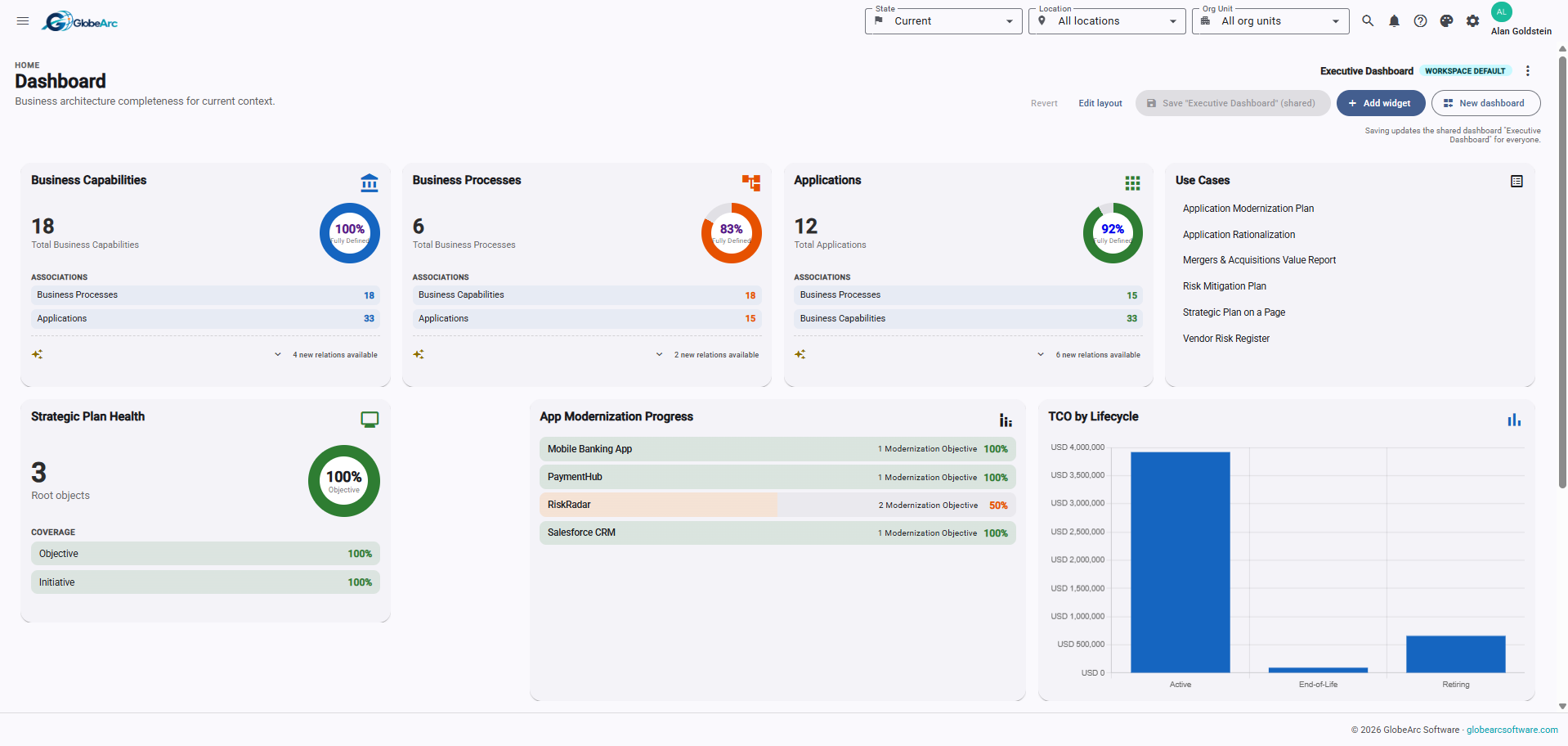
Enterprise architects commonly lead the analysis because application rationalization requires a connected view of the application portfolio, business capabilities, costs, technical condition, and dependencies. CIOs and technology leaders typically provide sponsorship and use the resulting evidence to guide investment and portfolio decisions.
Application owners, business architects, finance teams, technology teams, and business stakeholders may also contribute information or validate assumptions. Rationalization works best as a business and technology decision, rather than an isolated exercise owned by IT alone.
Why Do Traditional Application Rationalization Exercises Fall Short?
Spreadsheets can inventory applications, but they struggle to show why an application exists, what depends on it, and what would happen if it disappeared. As data is copied between inventories, assessments, diagrams, and presentations, teams can also end up debating which version is current instead of discussing the decision itself.
A familiar pattern emerges: applications are scored, a retirement list is created, and then stakeholders challenge the recommendations because important business context is missing.
Questions quickly follow:
- What business capability does this application support?
- Is another application genuinely providing the same coverage?
- How was its Business Value score calculated?
- Why is its Technical Fit considered poor?
- What does the application cost?
- Which other applications integrate with it?
- What else depends on it?
- How complete is the information behind the recommendation?
A rationalization decision becomes much easier to defend when those questions can be answered from connected evidence.

How Do You Identify Redundant Applications?
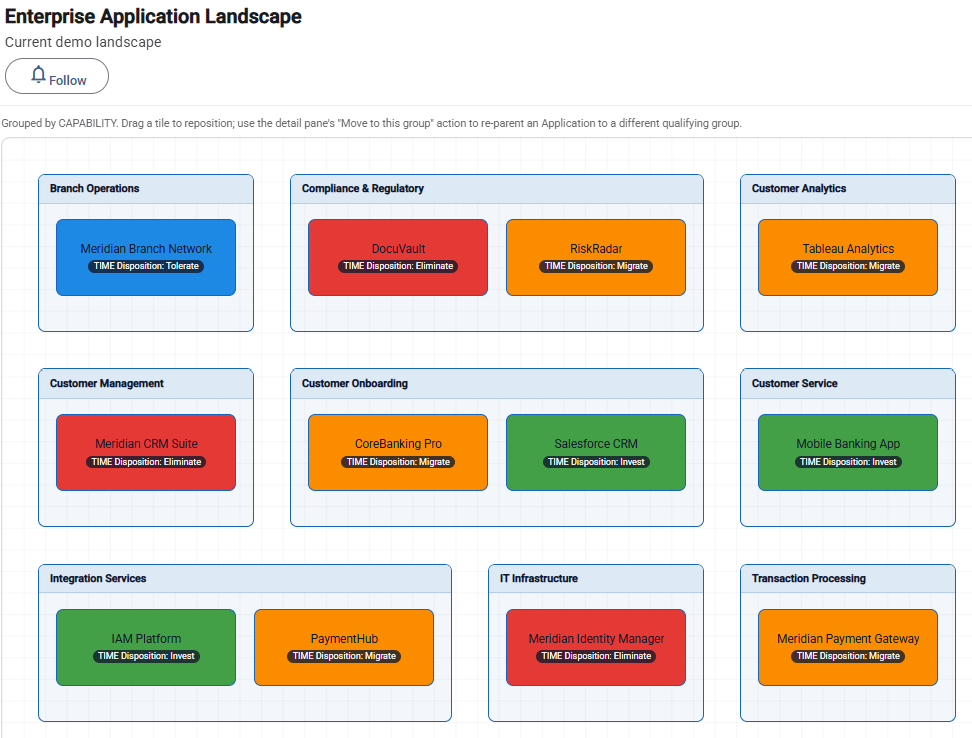
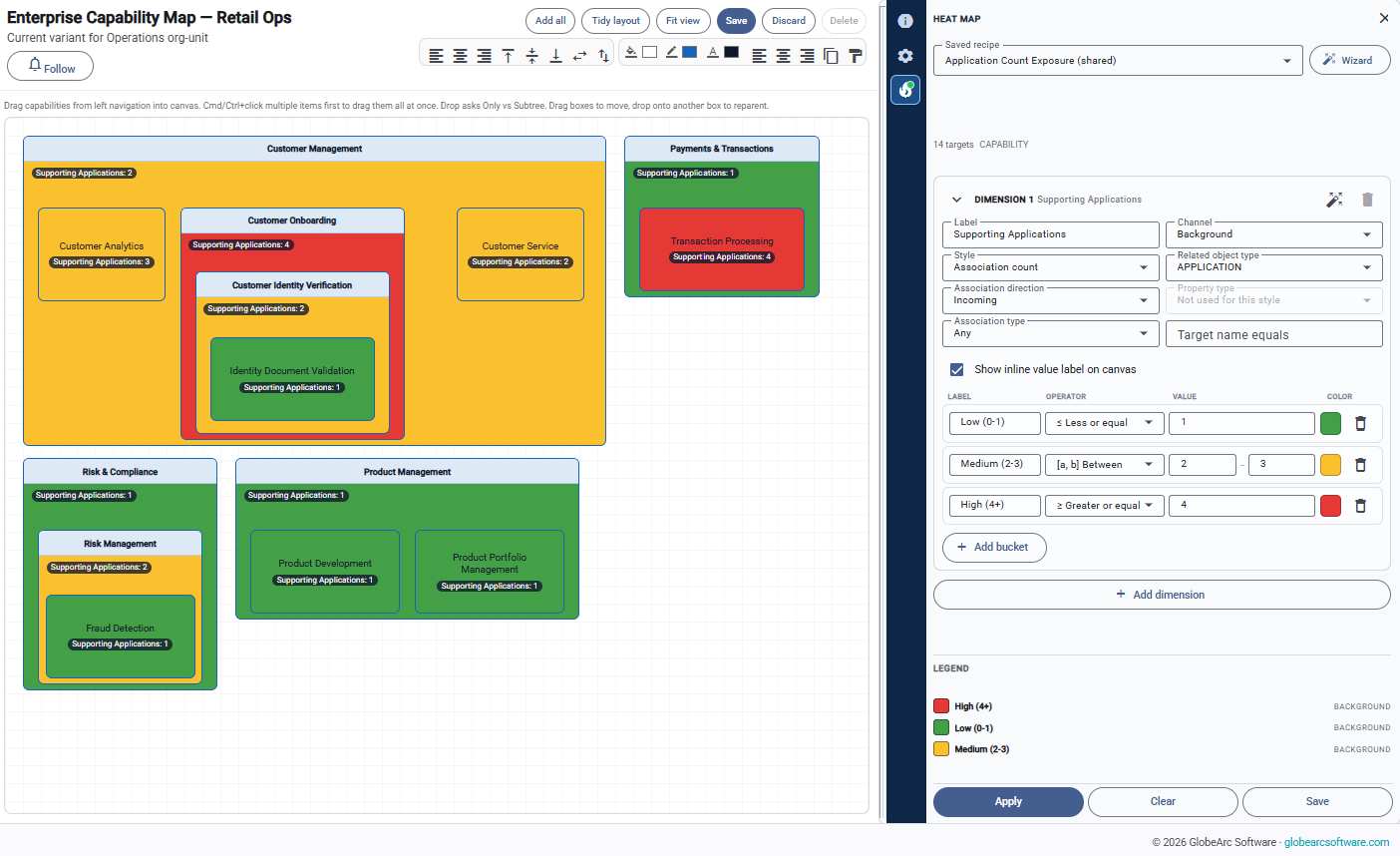
Redundancy becomes easier to identify when applications are viewed against the business capabilities they support rather than assessed as an isolated software list. Multiple applications supporting the same capability can reveal areas worth investigating for consolidation, replacement, or retirement.
GlobeArc connects applications to capabilities within the same repository, allowing teams to examine where application coverage overlaps. That overlap is a signal for investigation, not an automatic recommendation to remove an application.
Teams can then consider Business Value, Technical Fit, TCO, dependencies, and organizational context before deciding whether apparent duplication represents genuine redundancy.

How Do You Assess Business Value and Technical Fit?
Business Value and Technical Fit provide two distinct perspectives on whether an application deserves continued investment. Business Value considers how well an application contributes to organizational needs, while Technical Fit considers whether it remains suitable from a technology perspective.
GlobeArc supports calculated properties and configurable weighted formulas, allowing organizations to define the criteria that matter to their own portfolio. The underlying inputs remain visible, so teams can understand how the result was reached rather than relying on an unexplained score.
That distinction matters. An application with strong Business Value but poor Technical Fit presents a different decision from an application that performs well technically but provides little value to the business.

How Does Weighted Application Value Scoring Work?
Weighted scoring combines selected assessment criteria into calculated values that can be used consistently across the application portfolio. GlobeArc allows organizations to configure the inputs and weights behind measures such as Business Value and Technical Fit instead of imposing a fixed scoring model.
The calculation can then contribute to a calculated Disposition of Tolerate, Invest, Migrate, or Eliminate, and to wider portfolio analysis. A completeness indicator also helps teams see whether enough supporting information exists to place confidence in the assessment.
This gives reviewers two important pieces of information: the score itself and the quality of the evidence behind it.

How Does Application TCO Support Rationalization Decisions?
Application TCO adds financial context to the rationalization decision by showing the cost associated with maintaining an application alongside its business and technical value. A high-cost application may warrant closer examination when its value or fit is low, particularly where another application provides overlapping capability coverage.
GlobeArc can store and use application cost information within the wider portfolio analysis, including the Value Chart. It provides the application cost and architecture evidence organizations can use when building the financial case. That keeps the distinction clear between known portfolio data and assumptions about future savings.
How Do You Decide Whether to Tolerate, Invest In, Migrate, or Eliminate an Application?
Candidates emerge by examining Business Value, Technical Fit, cost, capability coverage, completeness, and dependencies together rather than relying on one metric. The combination helps teams distinguish between an application that is simply expensive and one whose cost is difficult to justify in the context of the value it provides.
The calculated Disposition places each application in one of four categories:
- Tolerate: keep the application in place without significant new investment
- Invest: continue to fund and improve applications that matter to the business
- Migrate: move the capability or workload to a better-suited platform
- Eliminate: retire applications whose value no longer justifies their place in the portfolio
Consolidation happens through these decisions: where two applications overlap, one is typically invested in or tolerated while the other is migrated or eliminated. These are decision candidates, not automatic instructions. Architecture context and stakeholder judgment remain essential before action is taken.

How Do You Identify Dependencies Before Retiring an Application?
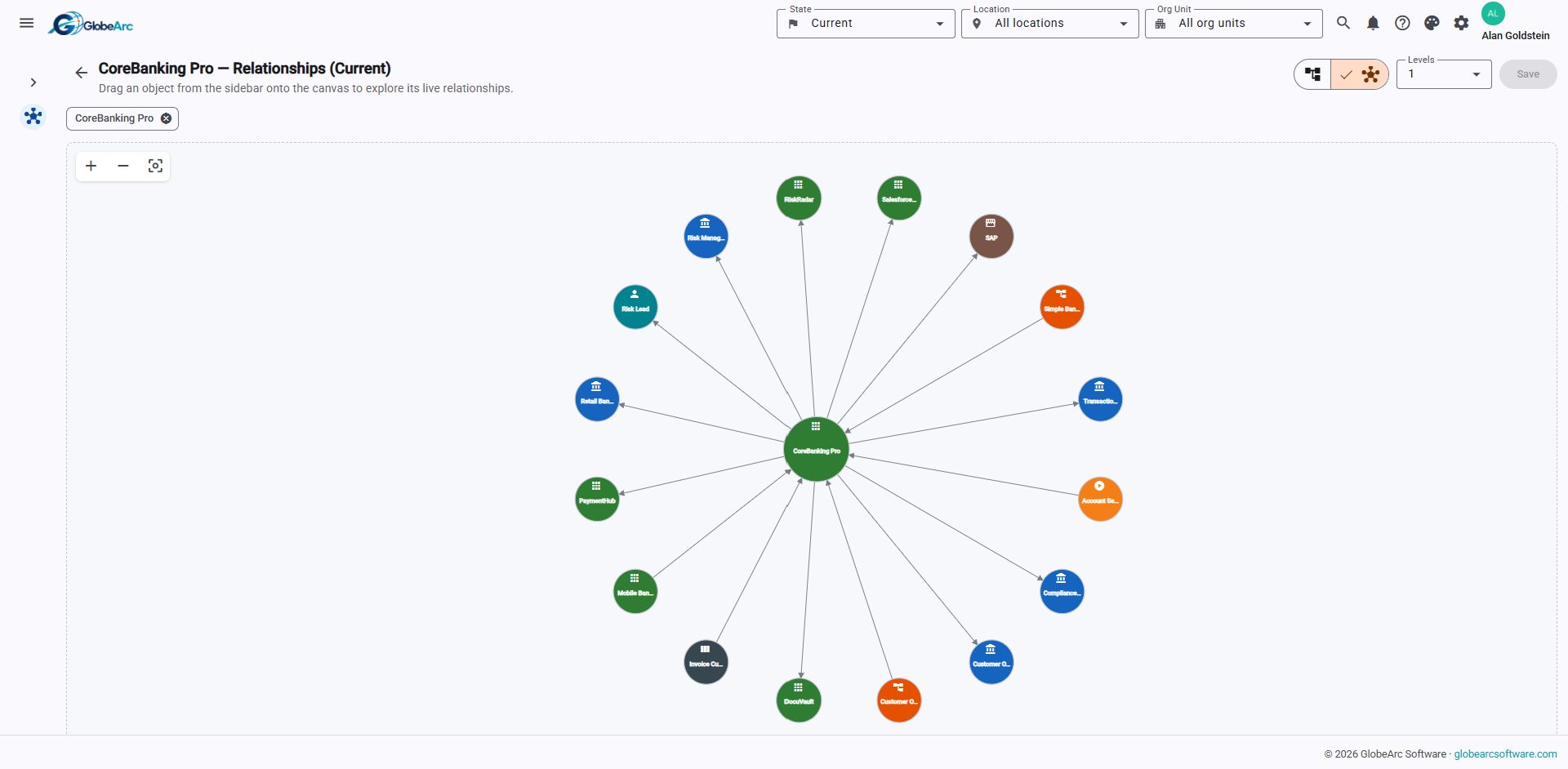
Dependencies should be examined before retirement because an application can appear expendable until its integrations and business relationships are considered. A defensible retirement decision therefore needs more than a low score or high cost.
GlobeArc's connected repository and Relationship Explorer let teams investigate relationships around an application, including its connections to capabilities and other applications. Integration relationships can add further context to the dependency picture.
Teams can investigate questions such as:
- Which capabilities does this application support?
- Which other applications integrate with it?
- Where else does this application appear in the architecture?
- What related objects need to be considered?
- Which BPMN processes use this application?
- Which organizational units would be affected?
The result is a stronger basis for deciding whether an application can actually be removed and what needs attention before that happens.
What is the Application Rationalization Blueprint?
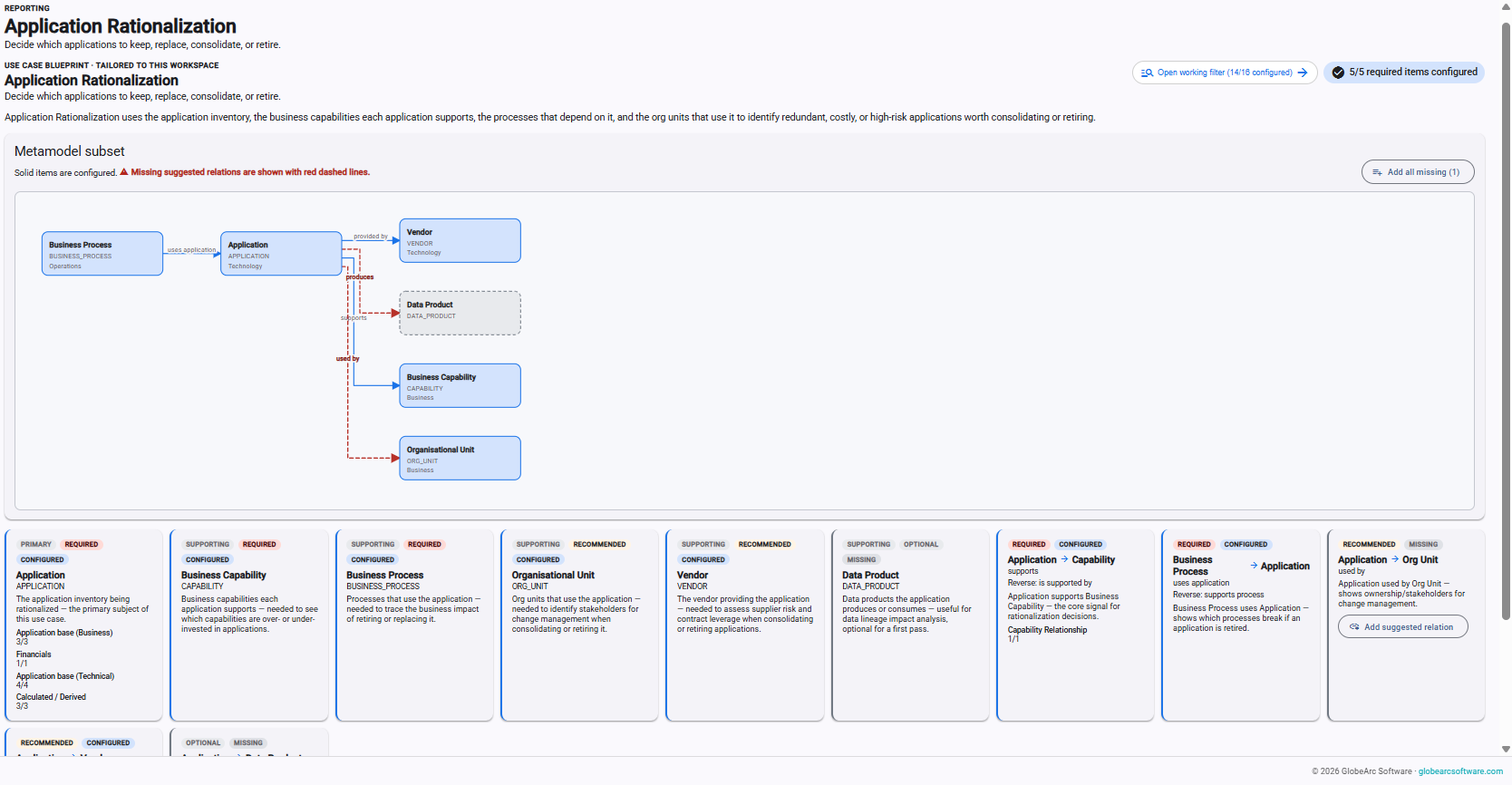
The Application Rationalization Blueprint guides teams toward the information needed to run the use case instead of requiring them to design the entire architecture model first. It checks the metamodel against the requirements of application rationalization and highlights information that is missing.
The Blueprint can identify required object types, association types, and properties, then help teams establish missing metamodel elements where appropriate. This provides a more guided starting point for organizations that know the decision they need to make but don't yet have every piece of architecture information structured.
What Does the Applications to Rationalize Query Show?
The Applications to Rationalize query provides a repeatable way to surface applications that meet the configured rationalization criteria. Because the query operates against the connected repository, its results can be examined alongside the application information and relationships that support the assessment.
GlobeArc also includes an Application Rationalization query report, giving teams a structured output for reviewing rationalization candidates. Rather than maintaining a separate shortlist manually, the analysis remains connected to the underlying architecture information.
What Does the Application Value Chart Show?
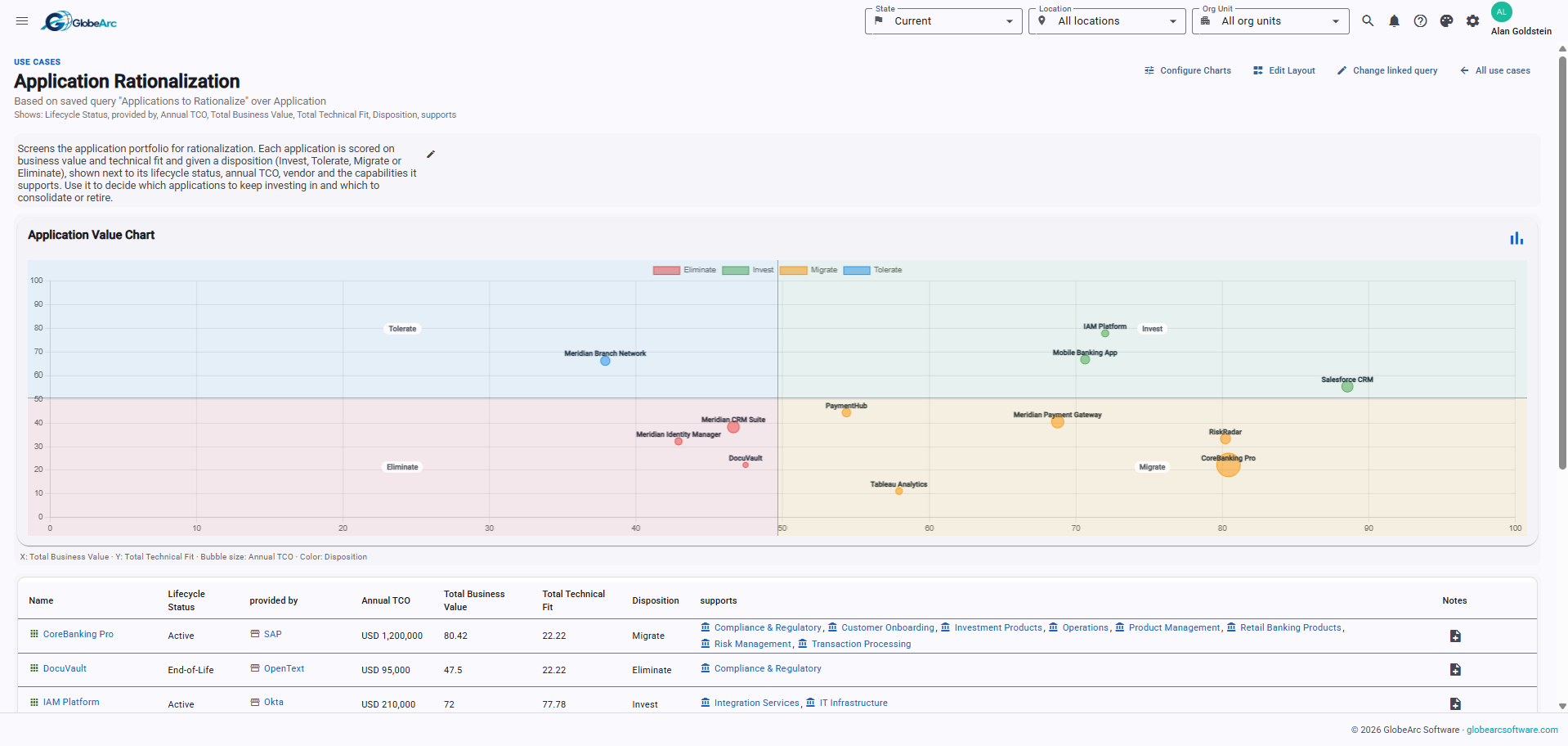
The Value Chart places applications visually according to Business Value and Technical Fit, making portfolio patterns easier to recognize than they are in a flat inventory. Total cost of ownership can be represented through bubble size, adding another dimension to the assessment.
Teams can use the chart to investigate clusters, outliers, and applications whose position warrants closer review. Thresholds and calculated Disposition help translate the assessment into decision context while keeping the underlying values available for scrutiny.
What Data Is Needed for Application Rationalization?
A useful first assessment needs enough application and business context to distinguish genuine rationalization opportunities from superficial overlap. Organizations don't need every architecture domain completed before they begin, but the quality of the decision improves as the relevant information becomes more complete.
Typical inputs include:
- Application inventory
- Business capability relationships
- Business Value assessment criteria
- Technical Fit assessment criteria
- Application cost or TCO
- Application relationships and integrations
- Relevant properties used in weighted scoring
- Current and Target state information where applicable
GlobeArc can import application objects and property values from structured Excel data, helping teams establish the initial portfolio more quickly. The GlobeArc team helps plan how existing relationship and dependency data is brought in during onboarding.
What Does an Application Rationalization Workflow Look Like?
A practical rationalization workflow moves from inventory to assessment, analysis, dependency review, and decision. GlobeArc keeps those stages connected so teams don't have to recreate the portfolio in separate tools as the initiative progresses.
A typical workflow is:
- Build or import the application inventory.
- Connect applications to the business capabilities they support.
- Capture cost and assessment data.
- Calculate Business Value and Technical Fit using agreed upon criteria and weights.
- Review score completeness before relying on the result.
- Use the Value Chart and Applications to Rationalize query to identify candidates.
- Investigate dependencies, integrations, and capability coverage.
- Review the evidence with application owners and business stakeholders.
- Determine whether applications should be tolerated, invested in, migrated, or eliminated.
- Use the resulting decisions to inform the Target application portfolio.
This makes rationalization repeatable rather than a one-off cleanup exercise.
What Decision Outputs Does GlobeArc Produce?
The outcome is a portfolio view that helps teams understand which applications deserve attention and the evidence behind those conclusions. Different GlobeArc capabilities provide different views of the same underlying application information.
Decision outputs can include:
- Business Value and Technical Fit scores
- Calculated application Disposition
- Application TCO
- Score completeness
- Capability coverage and potential redundancy
- Integration and dependency context
- Applications to Rationalize query results
- Application Rationalization report
- Value Chart portfolio analysis
- Current and Target application context
Together, these outputs give architecture teams a stronger basis for presenting recommendations to CIOs, application owners, finance teams, and business stakeholders.
What Other EA and BPM Solutions Support Application Rationalization?
Application rationalization often reveals the next architecture question rather than ending the conversation. A retirement or consolidation decision may lead directly into modernization, Target-State planning, M&A integration, or a deeper investigation of vendor exposure.
Related solutions include:
- Application Modernization and Landscape Management
- Transformation and Target-State Planning
- Mergers and Acquisitions Integration
- Vendor Concentration and Risk
Each use case can work from connected enterprise information, allowing the organization to reuse what it already knows instead of starting another disconnected assessment.
How Does Application Rationalization Support a Cost-Reduction Business Case?
A stronger cost-reduction case connects application cost to value, technical condition, redundancy, and dependencies instead of treating the most expensive applications as automatic targets. This helps decision-makers distinguish between necessary spend and cost that may no longer be justified.
GlobeArc provides the architecture and portfolio evidence needed to identify and investigate potential cost-reduction opportunities. The organization can then apply its own financial assumptions to calculate projected savings, migration costs, contract implications, and other business-case factors that sit outside GlobeArc's calculated rationalization outputs.
The result is a more defensible conversation: not simply "this application costs too much," but "this application has this cost, provides this value, has this technical fit, overlaps in these areas, and has these dependencies."

Who Uses GlobeArc for Application Rationalization?
Enterprise architects typically lead the detailed analysis, while CIOs and technology executives use the resulting portfolio evidence to make investment, modernization, and cost decisions. Application owners, business architects, finance teams, and other stakeholders can contribute the context needed to validate individual recommendations.
For enterprise architects, GlobeArc provides the connected repository, scoring, queries, capability relationships, and dependency analysis needed to build the recommendation. For CIOs, it provides a clearer line from portfolio complexity and cost to the evidence supporting proposed action.
See Application Rationalization in GlobeArc
A rationalization recommendation is only useful if decision-makers can understand and defend the evidence behind it. GlobeArc brings value, technical fit, cost, completeness, capability coverage, and dependencies together so teams can move from an application inventory to a decision-ready portfolio view.
Request a demo to follow an application from scoring and portfolio positioning through capability coverage and dependency analysis, and see how GlobeArc supports decisions to tolerate, invest in, migrate, or eliminate each application.
We’re here to help you bring clarity to complexity.