Why GlobeArc?
Connected Enterprise Intelligence
Enterprise Architecture and Business Process Management Software Comparison
Choosing Enterprise Architecture and Business Process Management software is not just a comparison of feature lists. Connected data, capability modeling, application portfolio analysis, process modeling, and future-state planning are increasingly expected, so broad promises of visibility alone do not explain how one platform differs from another.
GlobeArc’s differences are structural. Enterprise Architecture and Business Process Management share one canonical repository, BPMN process models connect to the wider enterprise model, Current, Interim, and Target states are built into the planning context, and shared analytics operate across multiple model types.
The result is one platform designed around connected enterprise and process information rather than separate disciplines that need to be reconciled later.

Key Differences
How Is GlobeArc Different From Traditional EA and BPM Software?
The most useful comparison is not how many features a platform lists, but how its underlying information is structured and reused. GlobeArc starts with one canonical repository of Objects, Associations, and Properties, then uses that foundation across process models, capability maps, value streams, application landscapes, analytics, queries, and reports.
The distinction isn't that every alternative works the same way. It doesn't. The point is to give buyers a practical framework for examining how an EA and BPM platform handles the information underneath its features.
Traditional or Modular Approach
- Architecture information may be distributed across tools, modules, or models
- Enterprise Architecture and Business Process Management may require separate modeling environments
- Different views can require synchronization or repeated modeling
- Future-state planning may use separate scenarios, branches, or models
- Analytics can vary by model or module
- Implementation can begin with extensive metamodel design
- AI access can introduce another integration and security layer
- Process analysis may sit in a separate module or tool
GlobeArc Approach
- One canonical repository supports multiple architecture and process views
- BPMN processes connect to the same enterprise objects used elsewhere
- The same underlying record can be reused across views
- State is a native planning context alongside Location and Org Unit
- One heat-map engine works across multiple visual model types
- Use Case Blueprints guide setup around specific business questions
- AI querying uses authenticated, scoped, validated access without raw database queries
- Simulation and Current vs Target analysis run on connected BPMN models
What Does One Canonical Record Change?
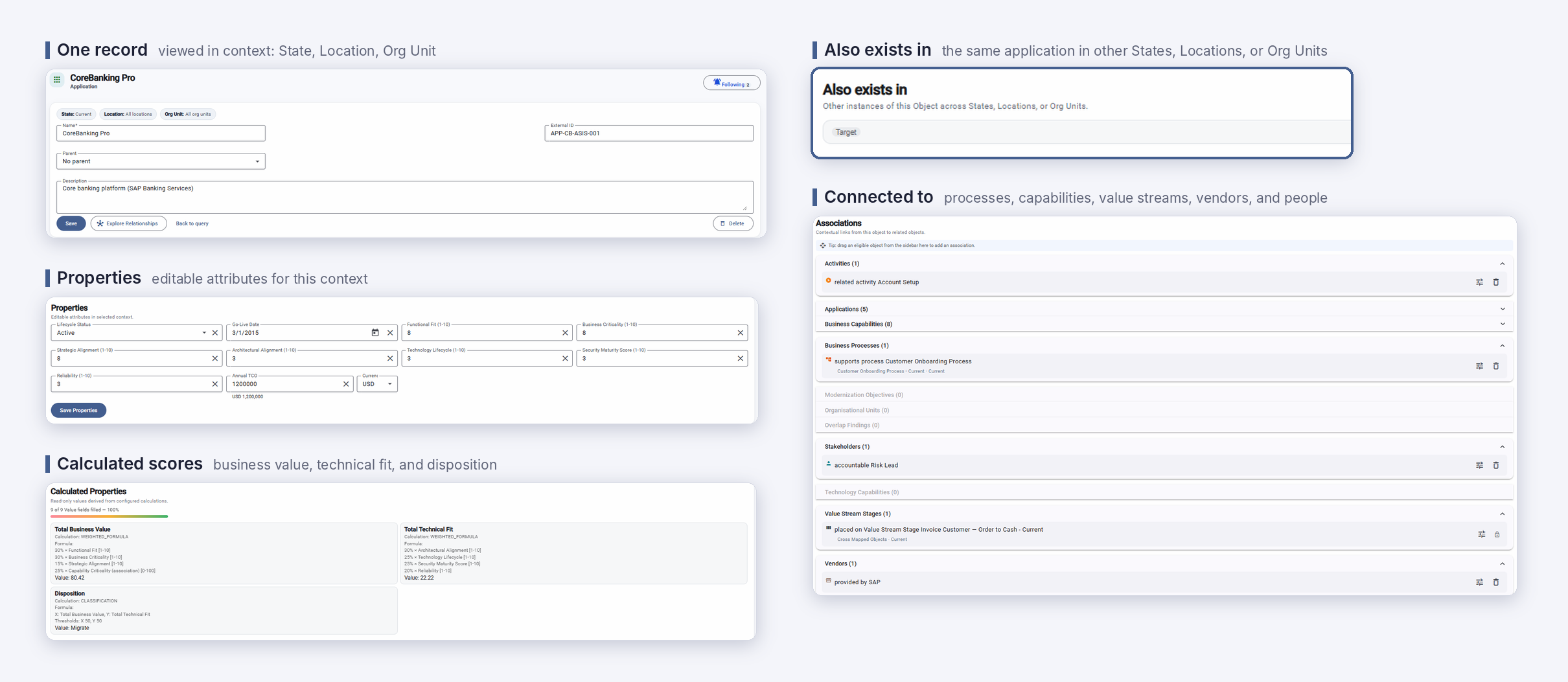
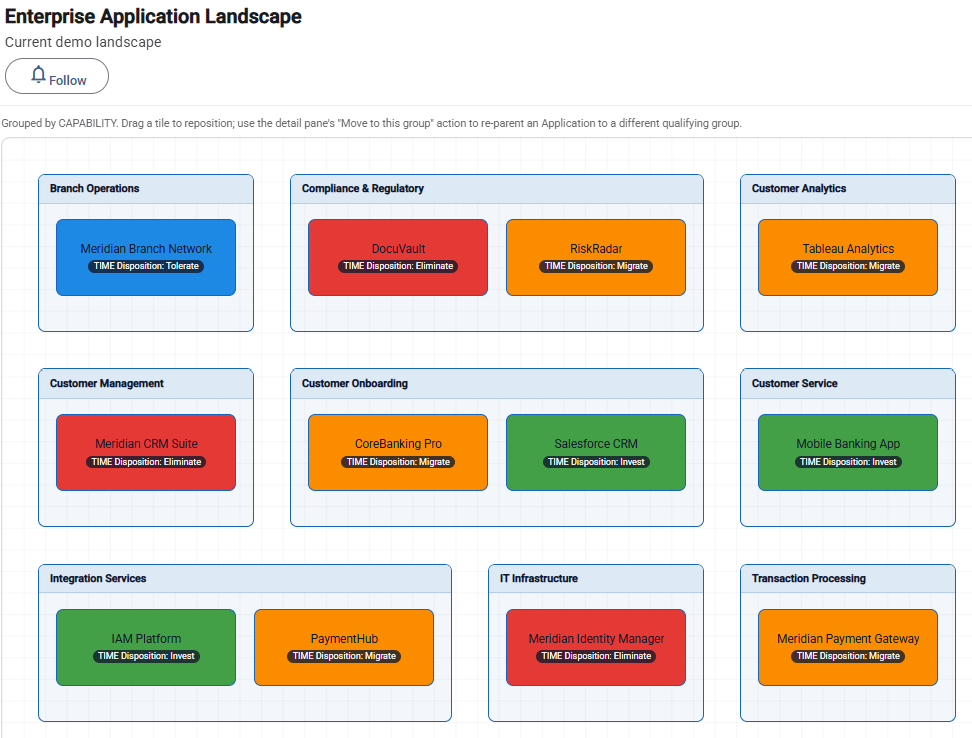
In GlobeArc, an application used in an application landscape can be the same application referenced by a capability, connected to a process, returned by a query, or analyzed in a report. The platform doesn't need to create a separate version of that application simply because the user changes views.
That principle extends beyond applications. Capabilities, processes, stakeholders, organizational units, value stream stages, initiatives, and other enterprise objects can participate in multiple relationships while remaining part of the same repository. This helps reduce duplication and makes it easier to trace how one part of the organization connects to another.
Update Once, Reflect the Change Across Views
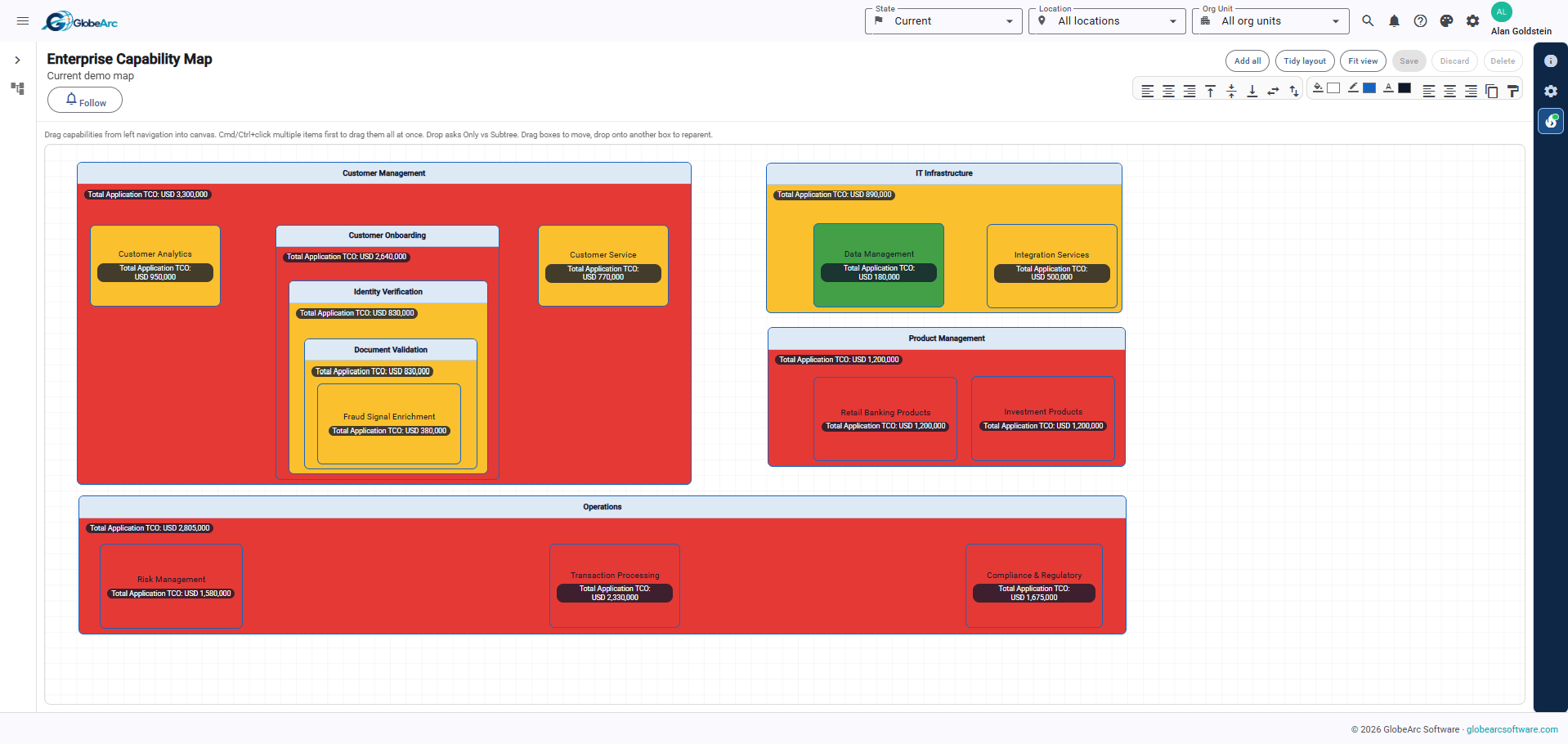
When multiple views draw from the same underlying information, maintaining architecture becomes less about keeping diagrams synchronized. Change the underlying record, and the updated information can be reflected wherever that record is used.
This doesn't mean every view shows the same information. A capability map, BPMN model, application landscape, and report serve different purposes. They can present different perspectives while still drawing from a shared source.
Why Combine Enterprise Architecture and Business Process Management?
Enterprise Architecture and Business Process Management describe different aspects of the organization, but they depend on much of the same information. Architecture explains how business and technology fit together, while process management shows how work is structured and performed. GlobeArc connects both through one repository so process models and architecture views can share the same applications, capabilities, organizational units, stakeholders, and other enterprise objects.
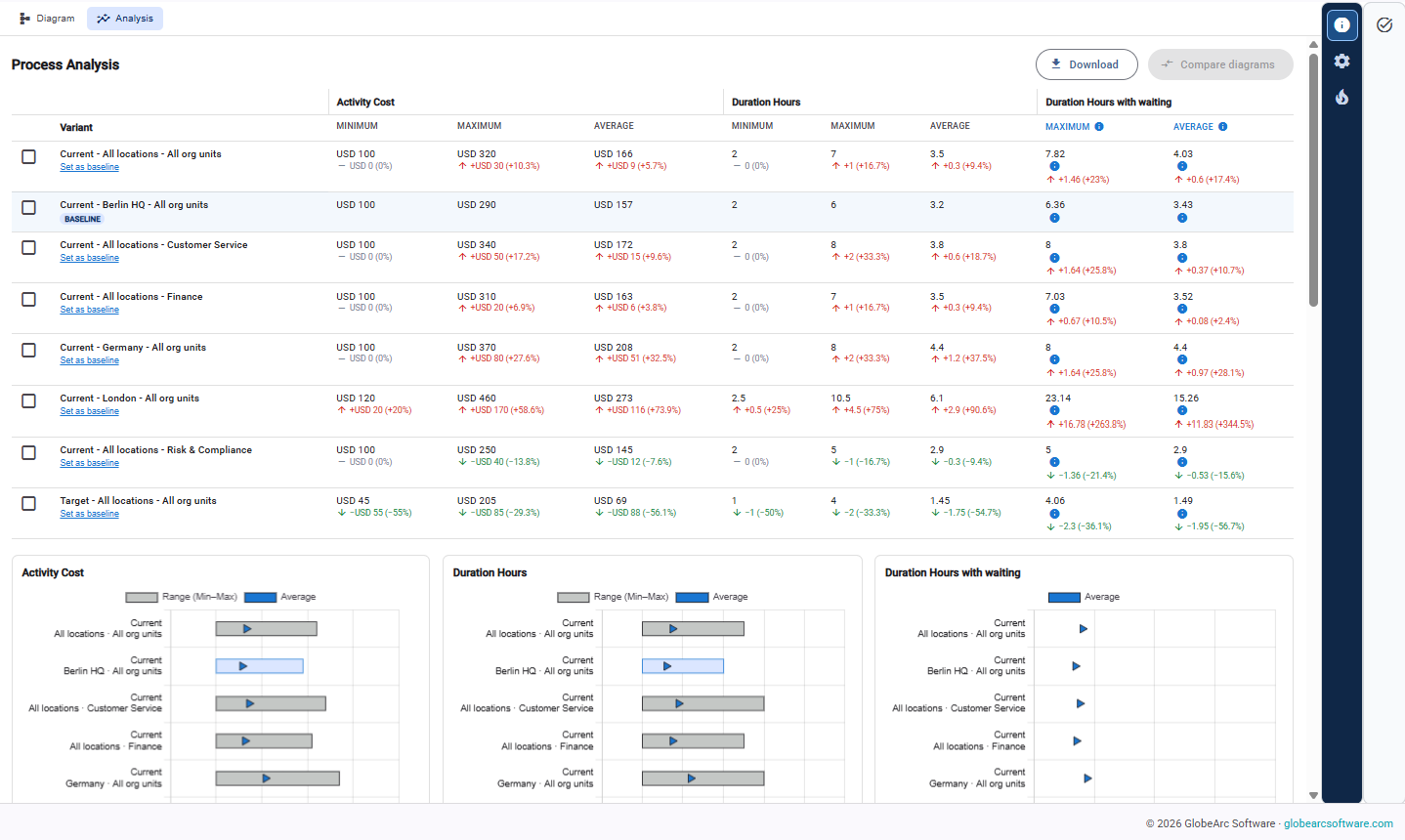
GlobeArc goes beyond documenting processes. Teams can simulate a BPMN model, trace work through it, and compare Current and Target variants on cost, duration, waiting time, and team capacity. GlobeArc isn’t a process mining tool or an engine for running day-to-day business operations. Its advantage is that process analysis draws on the same enterprise information used for architecture and transformation decisions.
The connection helps teams answer questions that cross the boundary between architecture and operations:
- Which processes depend on an application being considered for retirement?
- Which organizational units participate in a process?
- Which capabilities connect business change to the application landscape?
- Where does a stakeholder or organizational unit appear across process models?
- How does a proposed process differ from its Current state?
- What other architecture information is connected to a process?
How Does GlobeArc Keep Current and Target States Connected?
Current and future-state modeling isn't unique to GlobeArc. Established EA and BPM platforms also provide ways to model, compare, and analyze future architectures. GlobeArc's distinction is how planning context is represented in its underlying model.
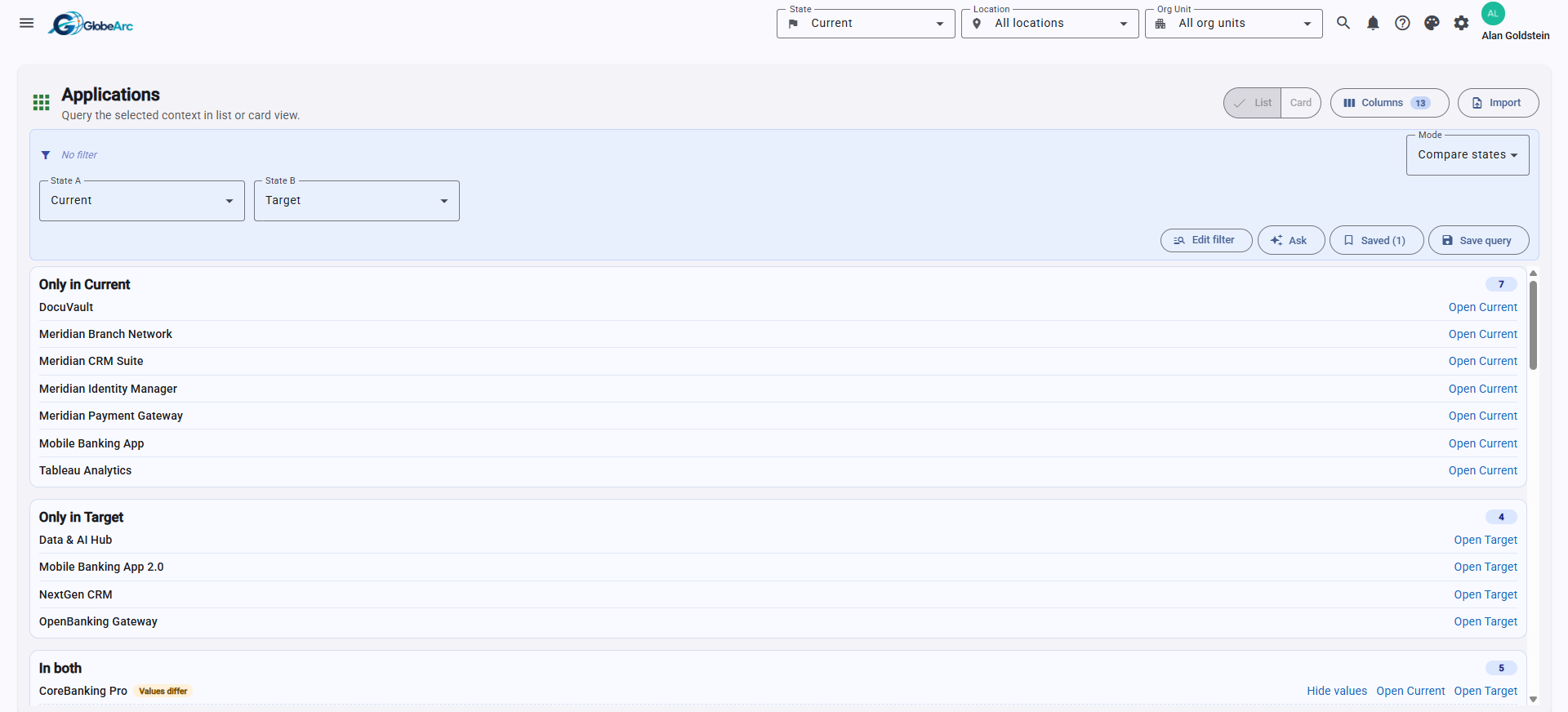
State is a structural context alongside Location and Org Unit. Current, Interim, and Target states can therefore be represented within the same architecture foundation rather than requiring teams to treat each state as an unrelated copy of the organization.
Teams can compare states to understand what has been added or removed and how relevant properties have changed. Location and Org Unit add further context, allowing the architecture to reflect legitimate differences between regions and parts of the organization.
How Does GlobeArc Use One Analytics Engine Across Different Models?
Analysis shouldn't have to start over whenever an architect changes visual perspective. GlobeArc uses a shared heat-map engine across business capability maps, value streams, BPMN process models, and application landscapes.
This allows the analytical lens to follow the business question across different views. A team investigating exposure, cost, risk, value, or another configured property can examine that information in the model that provides the most useful context.
GlobeArc also supports calculated properties, including sums, averages, weighted formulas, and classifications. These can support transparent scoring and other analyses while keeping the underlying calculation connected to repository information.


How Does GlobeArc Reduce the Work Required to Get Started?
A flexible enterprise metamodel is valuable, but flexibility can create another problem: organizations may spend too much time designing the architecture repository before they get useful answers from it.
GlobeArc's Use Case Blueprints approach the problem from the opposite direction. Start with the business question, identify the information required to answer it, and then determine whether the metamodel contains the necessary Objects, Associations, and Properties.
A Blueprint can:
- Define the architecture information required for a use case
- Identify gaps in the existing metamodel
- Show missing object, association, or property types
- Help create missing metamodel elements
- Provide a more guided starting point for architecture analysis
The GlobeArc team works with each customer during onboarding to bring in the relationships that matter most.
How Does GlobeArc Approach AI Differently?
Adding AI to enterprise architecture isn't difficult if the objective is simply to connect a language model. The harder question is how much authority that connection receives over sensitive architecture information.
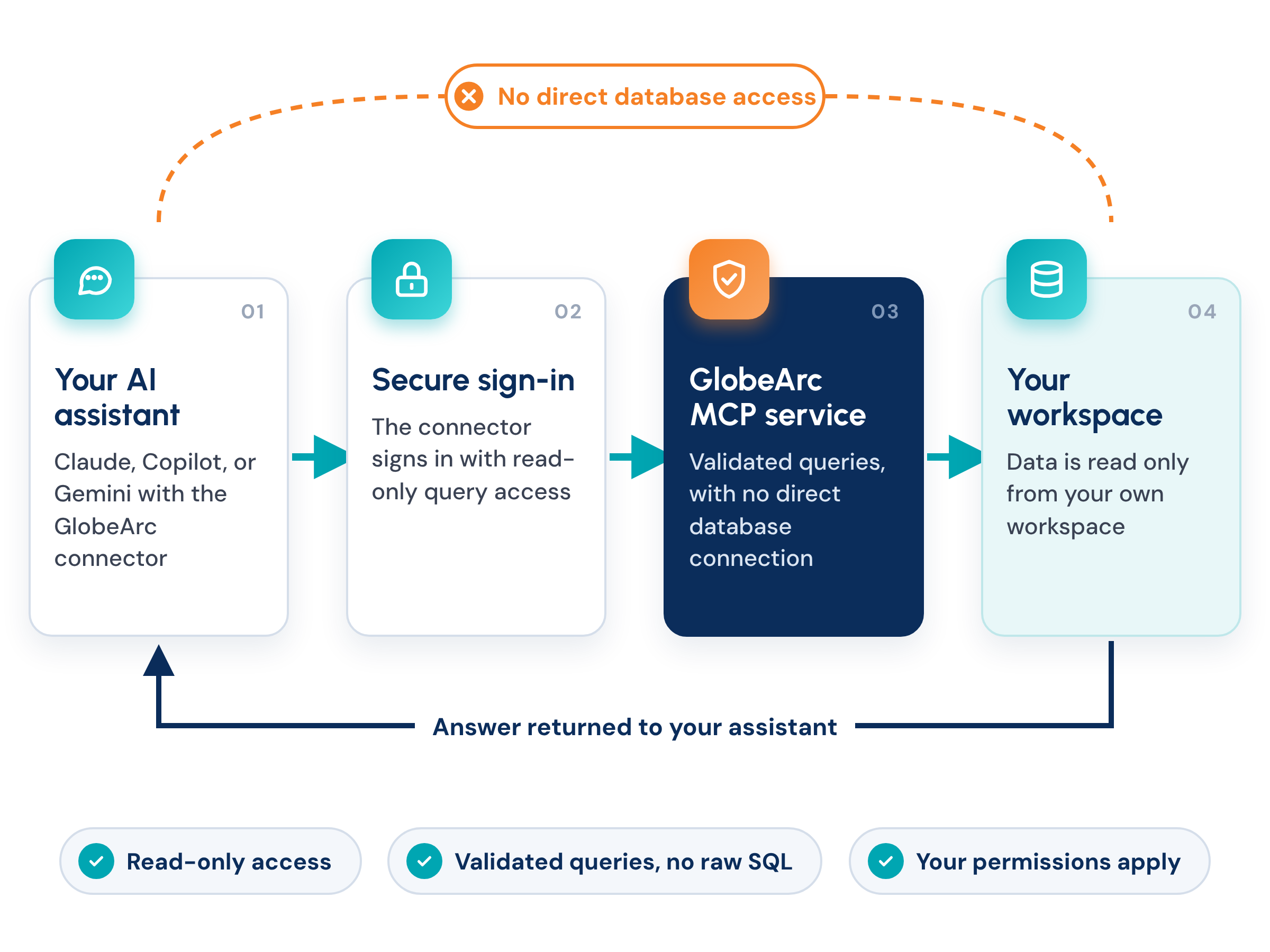
GlobeArc's generally available MCP capability uses the platform's controlled query architecture rather than allowing an AI assistant to generate raw SQL against the repository. AI query access is authenticated, scoped, read-only, and subject to the platform's tenant and permission controls. Users can ask questions with the built-in Ask feature or their company's own AI assistant.
The design separates different levels of authority:
- Architecture querying uses a read-only pathway.
- Queries use a validated AST rather than AI-generated SQL.
- The MCP service doesn't connect directly to the database.
- OAuth scopes constrain permitted operations.
- Tenant and authorization controls remain enforced.
- Process-model creation uses a separately permissioned pathway.
- Generated BPMN models pass through validation before persistence.
The distinction is less about putting an AI label on enterprise architecture and more about controlling what an AI-assisted interaction is actually allowed to do.

Is GlobeArc a Modern Cloud-Native EA and BPM Platform?
GlobeArc was designed as a multi-tenant SaaS platform rather than as legacy architecture software subsequently moved into hosted infrastructure. It is hosted on Microsoft Azure, uses Auth0 for authentication, isolates each customer's data in its own database schema, enforces role permissions on the server, and uses automated, version-controlled deployment.
That foundation also influences how GlobeArc evolves. Features such as connected modeling, dynamic queries, contextual architecture states, and controlled AI access are built on a common application architecture rather than being added as independent products that then need to exchange data.

What Does Practitioner-Led Product Development Mean for GlobeArc?
GlobeArc is developed around the questions architects, process professionals, and transformation teams need to answer in real organizations. That perspective shows up in decisions such as making Current and Target states structural, connecting BPMN to enterprise objects, exposing the logic behind application value scoring, and guiding metamodel setup through use cases.
GlobeArc focuses on connecting architecture and process information, and it works alongside specialist tools for process mining, GRC, and project portfolio management.
GlobeArc's focus is different: connect architecture and process information deeply enough that teams can understand dependencies, compare change, analyze the same information from different perspectives, and make decisions without continually reconstructing the organization.
How Should You Compare GlobeArc With Other EA and BPM Platforms?
There isn't one universally best EA and BPM platform for every organization. The useful question is whether the structure of the platform matches the problems your organization is trying to solve. When comparing GlobeArc with other software, look beneath the feature checklist and ask:
- Does the same canonical record support different models and views?
- How are enterprise architecture and business process models connected?
- What happens when shared information changes?
- How are Current, Interim, and Target states represented?
- Can analytics operate consistently across different model types?
- How much setup is required before the platform answers useful questions?
- Can the metamodel adapt to the organization's needs?
- How does AI access architecture data, and what is it actually permitted to do?
- Are authentication, authorization, and tenant controls preserved for AI access?
- Was the platform designed for modern SaaS operation?
Those questions reveal architectural differences that a simple feature matrix can miss. GlobeArc's proposition is built around the answers: one connected repository, native EA and BPM context, structural planning states, shared analytics, guided setup, controlled AI access, and a modern SaaS foundation.

We’re here to help you bring clarity to complexity.