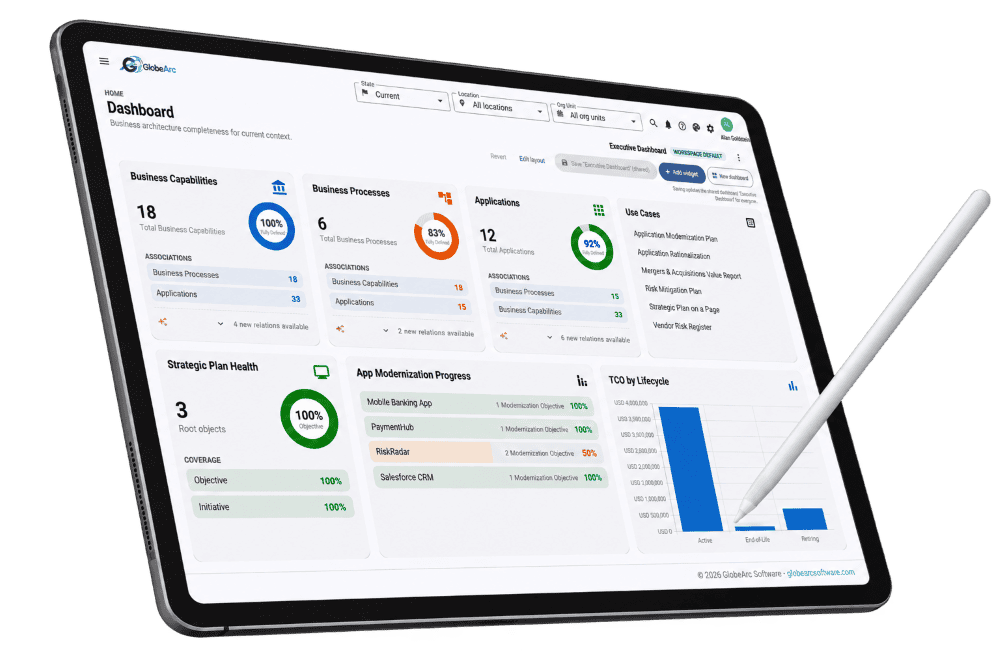
Application rationalization is intended to reduce IT costs, eliminate unnecessary complexity, and improve the efficiency of an organization's application portfolio. The process typically begins with evaluating existing applications, identifying potential redundancies, and determining which applications can be retired or consolidated. However, even a well-structured rationalization plan can encounter significant obstacles during implementation.
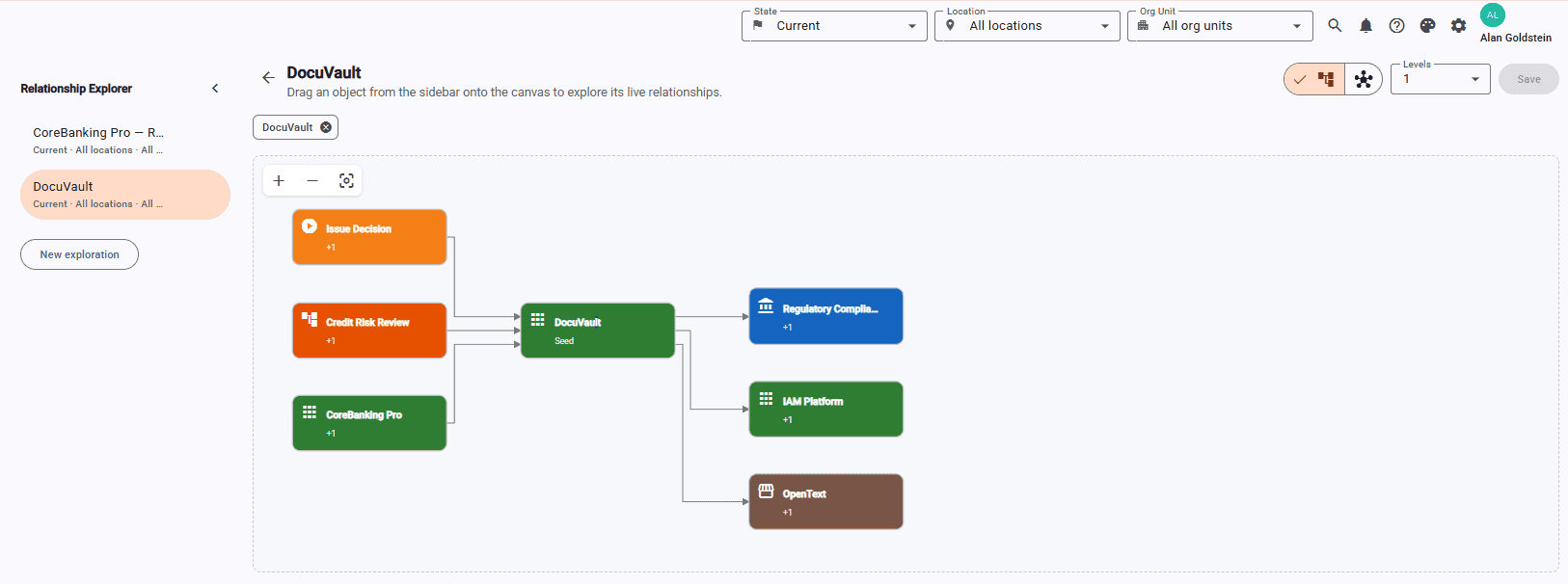
Seeing what depends on an application in GlobeArc (example data)
Business leaders may challenge proposed retirement decisions, while application users identify operational requirements and dependencies that were not considered during the initial assessment. As these concerns emerge, retirement timelines are extended, and applications originally identified for elimination remain in use.
One of the key application rationalization challenges is evaluating applications without sufficient understanding of the business processes they support. Traditional portfolio assessments often emphasize application costs, technical characteristics, and functional overlap without fully examining operational dependencies.
Understanding why application rationalization fails requires looking beyond the application portfolio itself. The critical question is not simply which applications an organization owns or how much they cost, but which business processes, activities, and organizational units depend on them.
I’ve spent more than 20 years working on both sides of this problem: in process improvement, operations, and risk, and in enterprise architecture. The most consistent lesson I’ve learned is that applications and processes aren’t two separate conversations. Rationalization decisions hold up best when both are part of the same picture.
Four Common Application Rationalization Challenges
1. Rationalization Decisions Focus on Cost and Technical Fit Alone
Total cost of ownership (TCO), licensing expenses, and technical fit are important criteria in application portfolio management. However, these factors alone do not provide a complete picture of an application's operational value.
In my experience, usually the biggest common mistake is that it is just the enterprise architecture group within IT that is doing the analysis, so decisions are made around cost and technical fit. Those are essential inputs, but there are dependencies that get missed because the business side’s understanding of how the work actually gets done isn’t included.
An application identified as costly or technically outdated may still support a critical business process or activity that no other system in the existing portfolio can adequately perform.
Without understanding these process dependencies, retiring the application may create operational gaps rather than eliminate inefficiencies. Effective rationalization decisions must therefore consider not only an application's cost and technical characteristics but also the business processes it supports.
2. Hidden Application Dependencies Surface Later
Applications often develop operational dependencies that are not fully documented in the organization's application portfolio. These may include recurring financial reports, workarounds established by individual Org Units, or information exchanges between systems. When these dependencies are discovered after an application retirement decision has been made, they can delay implementation and require reassessment. If they remain unidentified until after decommissioning, they can disrupt established business processes.
Application dependency mapping is therefore an important part of rationalization planning. Identifying how applications interact with business processes, users, and other systems before retirement decisions are finalized helps organizations assess potential operational impacts and determine what changes are necessary.
3. Business Process Owners Are Excluded from Rationalization Decisions
Most rationalization analysis is written in IT language: application inventories, software versions, hosting environments, and system integrations. Business leaders and process owners evaluate applications from a different perspective, focusing on operational requirements, process continuity, and business outcomes.
This isn’t a criticism of architects. Many enterprise architects maintain they have no obligation to track business processes, and given how their role has traditionally been defined, that’s understandable. Process data has historically lived in a different team’s tool, at a different level of detail, and often in diagrams that don’t connect to anything else. The gap isn’t about people. It’s about how the two disciplines have been set up to work.
When rationalization assessments fail to connect technical findings with business process requirements, stakeholders may lack the information needed to evaluate proposed changes and their consequences.
Involving process owners early in the assessment helps identify operational dependencies, clarify business requirements, and establish alignment between IT and business stakeholders before application retirement decisions are finalized.
4. Expected Cost Savings Are Offset by Operational Inefficiencies
Application retirement can reduce licensing, maintenance, and support expenses. However, these savings may be partially offset if the business activities previously supported by the application must be performed manually or transferred to systems that are not adequately suited to the work.
For example, replacing an established application workflow with spreadsheets, manual processes, or temporary workarounds may introduce additional administrative effort, longer process cycle times, or operational risks.
Without sufficient business process impact analysis, these indirect costs may not be identified during the initial rationalization assessment.
Evaluating the operational impact of application retirement alongside its expected financial benefits helps organizations determine whether proposed changes will deliver meaningful improvements in overall efficiency and cost.
What Process Context Adds to Application Rationalization
Effective application rationalization requires understanding not only which applications an organization maintains, but also how those applications support business operations.
Adding business process context involves connecting applications to the specific business processes, activities, and process steps they support, along with the people and organizational units responsible for performing that work.
This process-to-application mapping provides the foundation for more informed business process impact analysis. Rather than evaluating applications solely through portfolio inventories, organizations can examine their operational dependencies and assess the consequences of proposed retirement or consolidation decisions.
With these relationships established, organizations can address several important questions:
- Business process dependencies: Which business processes will be affected if an application is retired?
- Operational changes: Which process steps will need to change, and which employees or organizational units will be affected?
- Application redundancy: Do applications with overlapping functionality support the same business processes, or do they serve different operational requirements?
- Business impact: Will the proposed retirement affect customer-facing operations, internal processes, or both?
- Operational efficiency: How might the proposed changes affect operating costs, process cycle times, and team capacity?
These answers turn application rationalization from an IT cleanup exercise into a business decision that process owners can understand and support.
Enterprise architects are normally looking at just the IT side of the house. To make a decision that is fully supported, you need to understand the entire organization: the processes, the people who perform them, the data they rely on, and the applications that support them. When those are connected, the decision-maker knows what they do not know and can understand the impact with the highest possible confidence.
I recently walked through this with a former operations and business architecture leader from a health technology company. Her reaction captured the gap well: “It’s the first time I’ve seen many of the pieces actually put together to actually create value.” She described the problem as “the missing in the middle of connecting things,” adding that “no one’s ever been able to do that well, if at all.” That missing middle is exactly where rationalization decisions are won or lost.
To see how GlobeArc maps applications to the processes they support take the product tour.
How to Build Process Context Into Rationalization
Building process context doesn’t require modeling your entire organization first. A few principles make the biggest difference:
- Map applications to both business capabilities and processes. Capabilities show where applications overlap. Processes show whether that overlap is genuine redundancy or two systems supporting different work.
- Start with high-impact processes: the ones critical to customers, revenue, or compliance, and the ones that touch your largest rationalization candidates.
- Involve process owners before retirement decisions, not after. They know where the workarounds and undocumented dependencies are.
- Model current and target state for applications and processes together, so everyone has the same picture of the end state.
- Assign dispositions on the Application Value Chart with process impact in view. An application supporting a critical, customer-facing process may warrant a different decision than one with similar scores supporting a back-office report.
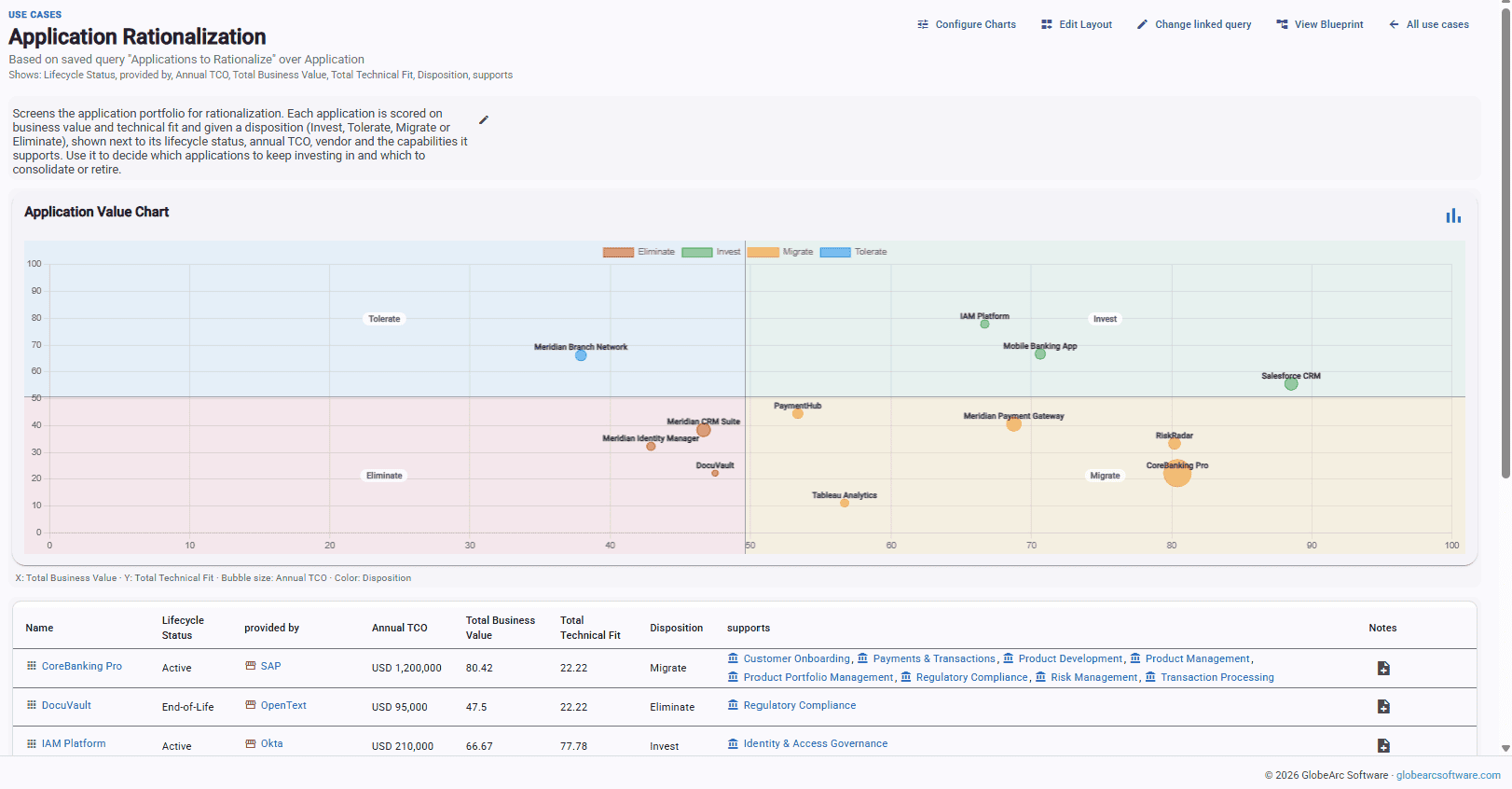
The Application Value Chart in GlobeArc, with each application’s disposition and the capabilities it supports (example data)
For the full step-by-step approach, including how to score applications on business value and technical fit, see How to Identify Redundant Applications (and the Processes That Still Depend on Them).
Bringing It Together
Application rationalization is ultimately a business change, not just a technology cleanup. Every application in the portfolio exists because someone, somewhere, uses it to get work done. Organizations that understand that work before they act make faster portfolio decisions, earn stronger support from the business, and keep more of the savings they set out to achieve. Bridging that gap between Enterprise Architecture and Business Process Management is the reason I started GlobeArc.
How GlobeArc Helps
GlobeArc brings Enterprise Architecture and Business Process Management together in one repository, connecting people, process, data, technology, and strategy in the same model. That lets you see which processes depend on each application, compare current and target states for both, and make rationalization decisions with the full picture in view.