Ask a call center agent how many ways there are to handle a support call, and you might be surprised by the answer. When I was leading Lean Six Sigma work at Johnson Controls, the answer was at least 24.
That’s what happens to processes over time. Each variation usually exists for a reason, but together they make the work harder for the people doing it, harder to manage, and harder to change. Standardizing those processes across locations and Organizational Units (Org Units) is one of the most valuable things an organization can do. It’s also one of the hardest to get right if you can’t see everything that supports the process.
Why Business Processes Vary Across Locations and Organizational Units
Johnson Controls managed facilities for multiple client companies, and support calls from all of them came into the same call center in Manila. Each client company, and in some cases each country, had its own support process.
When handling an incoming support call, agents had to navigate multiple process variations based on the client's company and geographic location. This required them to:
- Figure out which company the caller was from, and where
- Determine the applicable support process for that company and country
- Work out what questions to ask and what the next step was
- Identify the appropriate person or team to route the call to
The complexity extended beyond the number of processes to how each one was structured. Some support processes involved four steps, while others required eight. Escalation procedures also varied: certain calls were routed directly to an on-site senior manager, while others required escalation to a remote global manager before reaching an on-site manager. These differences across client companies and countries resulted in at least 24 distinct support processes across the global operations.
How Organizational Silos Create Process Inconsistencies
I saw a similar challenge when I worked with a global manufacturer operating across three largely independent divisions. The divisions made three very different product lines, from packaging to medical equipment to electronics components. Despite operating under the same organization, these divisions functioned largely as separate companies, creating operational silos.
Even within the same company, there were gaps. When the other divisions shipped their products using the company’s own packaging division, the processes didn’t always connect cleanly. Each silo was also using, in some cases, different applications for the same business capability across all three divisions.
Neither of these situations came from bad decisions. They came from growth, client requirements, and organizations that were set up in silos. Untangling them takes a structured approach.
Why Some Process Variations Cannot Be Eliminated
Before standardizing business processes across locations or organizational units, it is essential to distinguish between variations that can be modified and those that must be maintained. Some differences are necessary to meet regulatory requirements, country-specific rules, or individual client obligations.
The assessment should address two key questions:
- Which process variations can be adjusted or eliminated?
- Which variations must remain unchanged due to regulatory, country-specific, or client requirements?
Once these constraints are identified, the remaining process variations can be evaluated as candidates for standardization.
A Step-by-Step Approach to Standardizing Processes
1. Prioritize Processes Based on Strategic Importance and Complexity
Effective process standardization begins with selecting the right process to improve. Organizations should prioritize processes that are strategically important to the business while remaining manageable in complexity.
Standardizing processes with limited strategic relevance may deliver little meaningful value. Conversely, beginning with highly complex processes can make it difficult to demonstrate progress and achieve early results.
2. Identify and Engage Key Process Stakeholders
Successful process standardization requires identifying everyone involved in or affected by the process and engaging them early to ensure accurate information is collected.
A common oversight is consulting only the process owner, who is responsible or accountable for the process, while excluding other stakeholders who are consulted, informed, or involved in its execution.
Without understanding these relationships, organizations risk overlooking individuals, departments, or Org Units that depend on the existing process.
3. Map and Compare Current-State Processes
Before developing a standardized process, organizations need to document and compare how the same process operates across different locations, departments, or organizational units.
At Johnson Controls, we used a Kaizen to compare the existing processes. Each process was mapped individually and then overlaid with others to identify common tasks and variations.
We printed the processes on huge plotter paper and used sticky notes to visualize the workflows side by side. Although effective, the manual approach made comparing multiple process variations challenging.
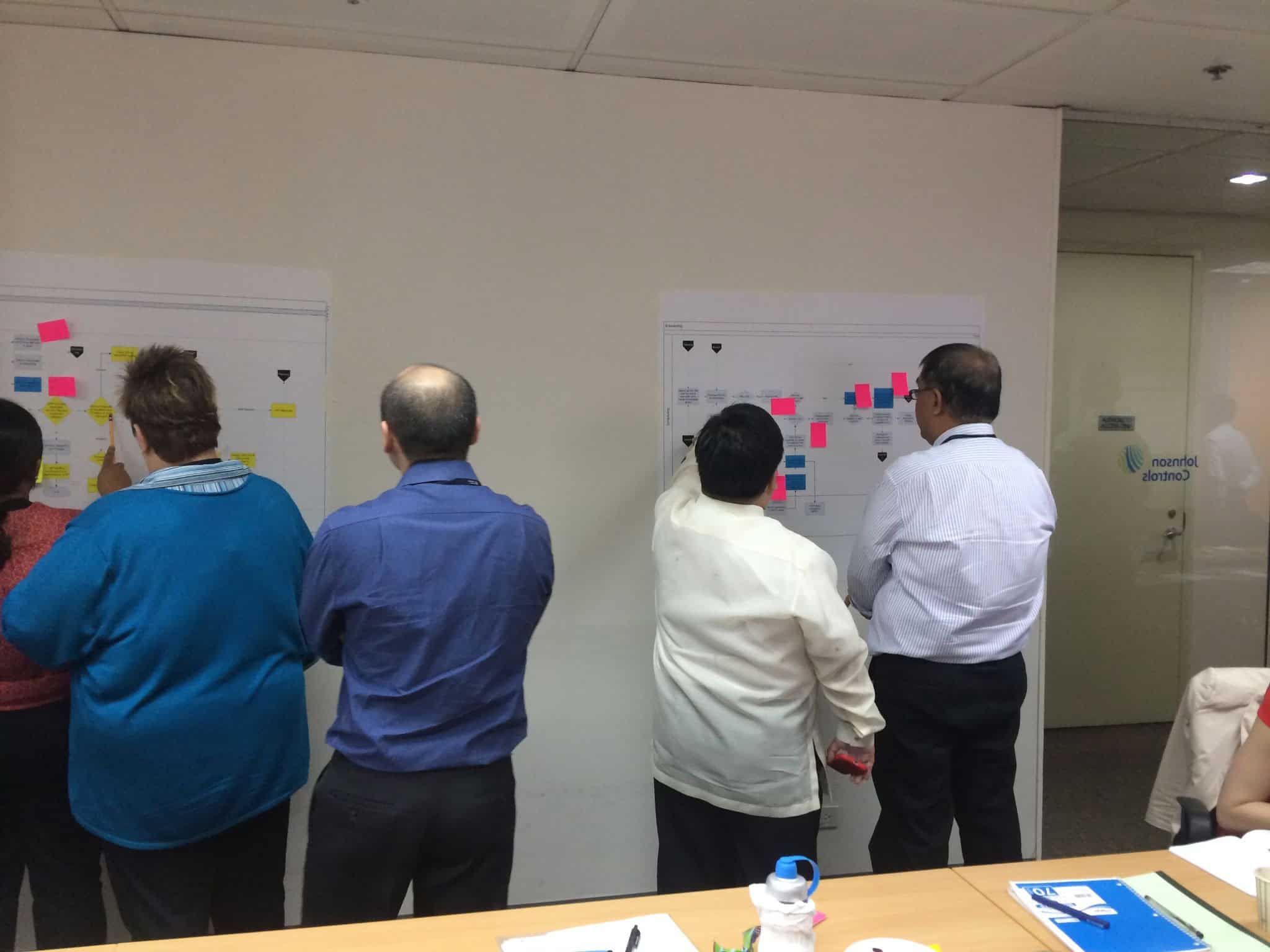
The Kaizen at Johnson Controls: each support process printed on plotter paper and compared by hand.
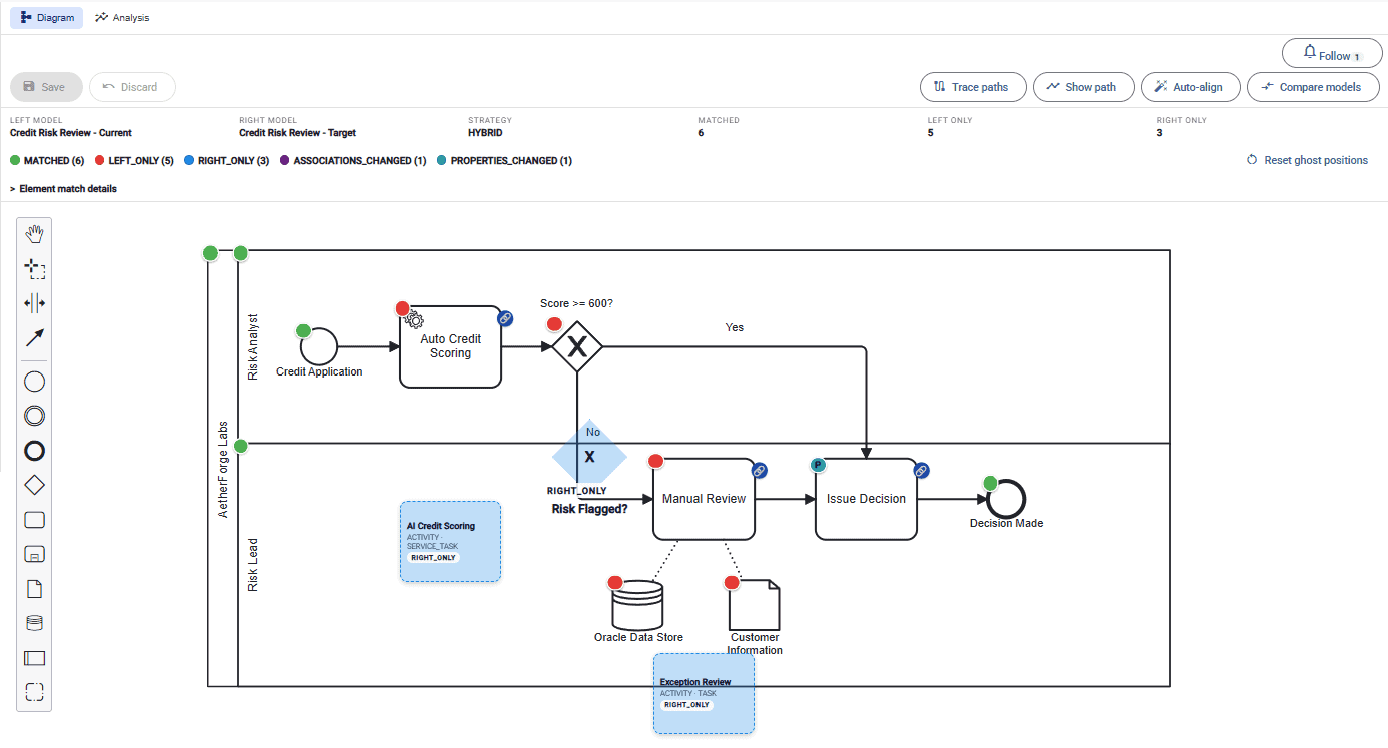
Comparing current and target state versions of a process in GlobeArc (example data)
4. Distinguish Required Process Variations From Those That Can Be Standardized
With the current-state processes side by side, apply the questions above to each difference. Keep only the variations required by regulatory, country-specific, or client requirements, and treat everything else as a candidate for standardization.
In GlobeArc, each variation of a process can be compared against the global standard. For each location or Org Unit, you can see how closely it conforms to the standard, how its activities, handoffs, roles, and applications compare, and how its annual cost differs from the baseline. You can record the reason behind each variation, such as a regulatory or customer requirement, and GlobeArc recommends whether that variation is justified, should be consolidated or redesigned, or is a best practice worth promoting to the standard.
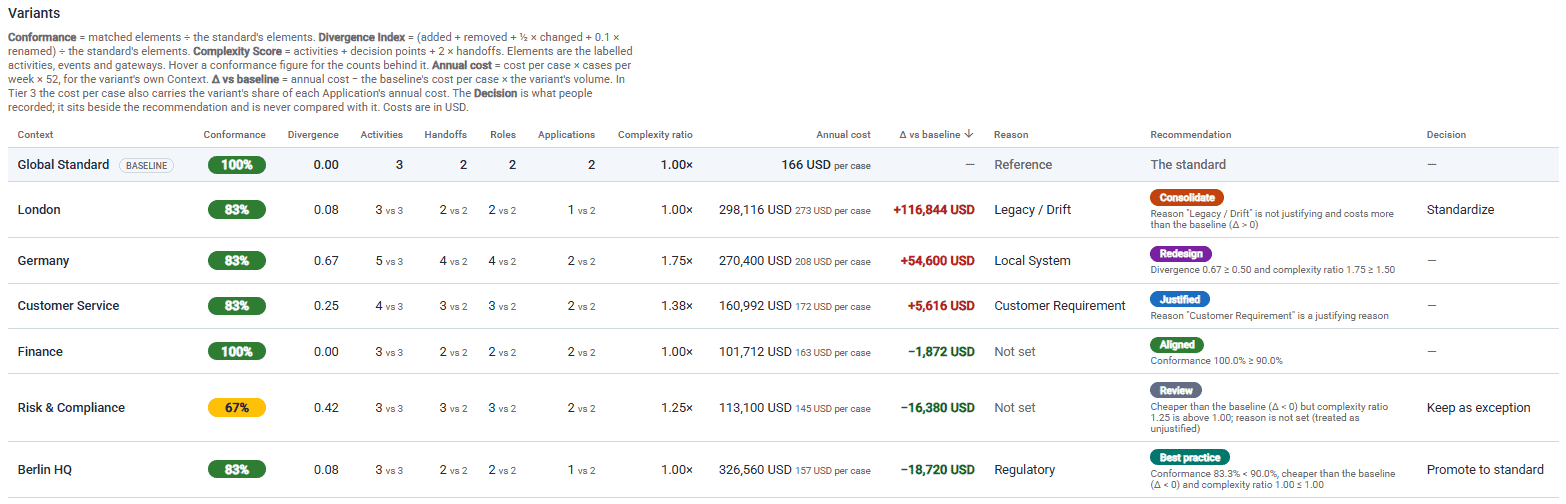
Comparing each location’s process variation against the global standard in GlobeArc (example data)
5. Evaluate Each Process Step
Based on Business Value
Once common process steps have been identified, organizations should evaluate each activity to determine its contribution to customer value, business operations, or regulatory compliance.
Each step can be classified into three categories:
- Value to the customer: Steps that directly contribute to outcomes or benefits valued by the customer.
- Required by the business: Steps necessary to meet operational, business, or regulatory requirements, even if they do not directly add customer value.
- Non-value-add: Steps that neither contribute meaningful customer value nor fulfill essential business or compliance requirements.
Remove the non-value-add steps. That’s how you decide which steps stay and which go.
6. Connect the Process to What Supports It
This is the step that’s easiest to miss, and it determines whether the standard really works. It’s very hard to standardize if you don’t know what’s supporting your process.
You might put in all the same steps, but if one location or Org Unit uses one application and another uses a different one, you don’t know that they’re actually working the same way. They may not be pulling from the same data on the back end. The global standard can be the same on paper, but you may still need required steps in between if you don’t understand the applications supporting each task and the data each task needs.
At the manufacturer, that meant looking at who was using which application for each capability, and deciding which ones each division would move to or merge onto, before the process itself could be made as easy as possible to move through.
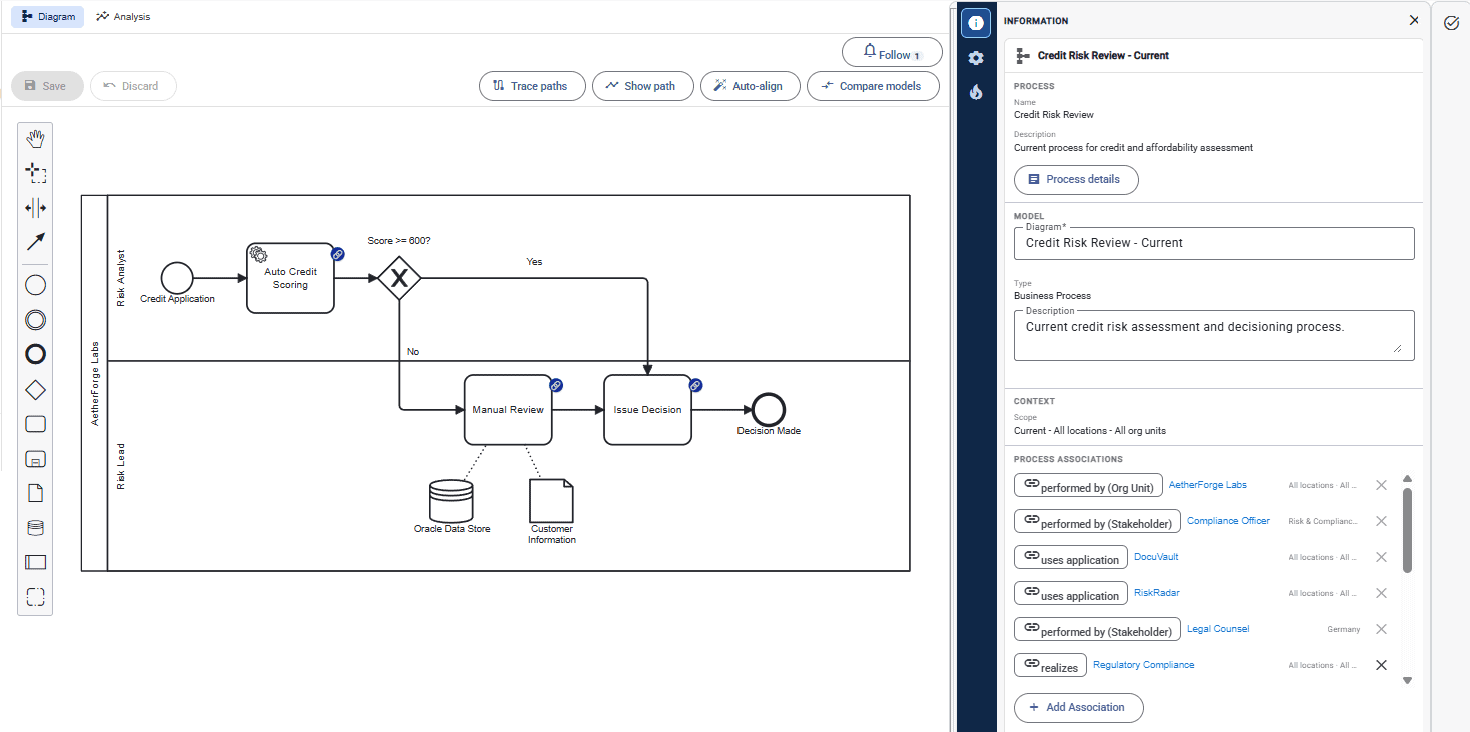
A process model with its applications, Org Units, and stakeholders connected in GlobeArc (example data)
7. Simulate and Compare Before You Commit
Leadership needs confidence that a change will move the organization toward its goal before asking people to change how they work. Compare the current state process with the target state and look at where things change:
- Is the cost per process going down?
- Is the duration of the process getting shorter?
- Are you reducing or increasing capacity?
Which of those matters most depends on the goal. The point is to see that you’re heading in the right direction.
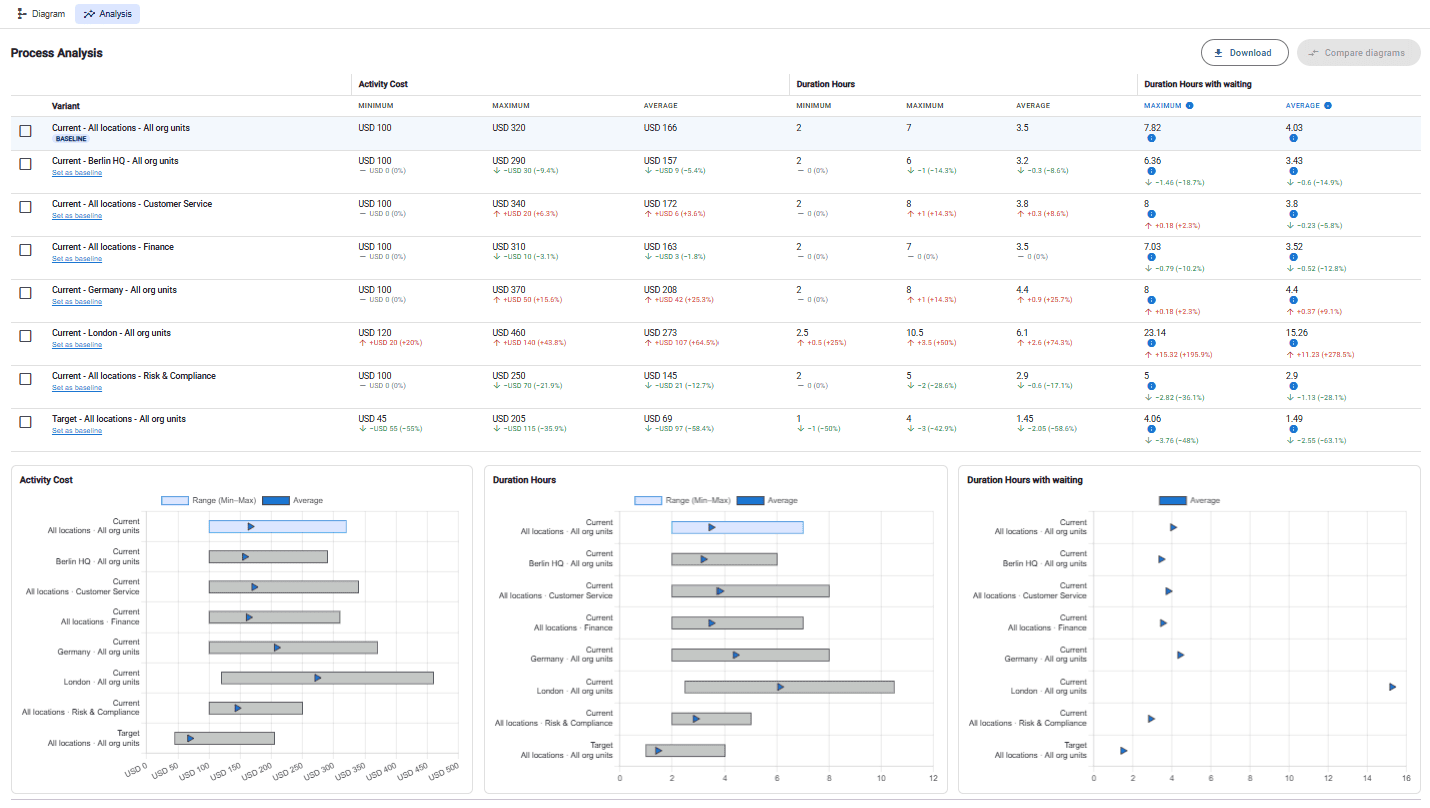
Process analysis comparing cost and duration across locations, Org Units, and the target state (example data)
Without that kind of simulation and analysis, the alternative has been to run a proof of concept for six months, see whether it got you closer to the goal, and if it didn’t, try something else for another period of time. That cycle can repeat until you find the right answer.
Explore how GlobeArc supports current-state and target-state process comparisons, including analysis of cost, duration, and capacity.
8. Pilot the Standardized Process Before Organization-Wide Rollout
Implementing a standardized process across multiple locations or organizational units requires a phased approach that accounts for differences in their existing operations.
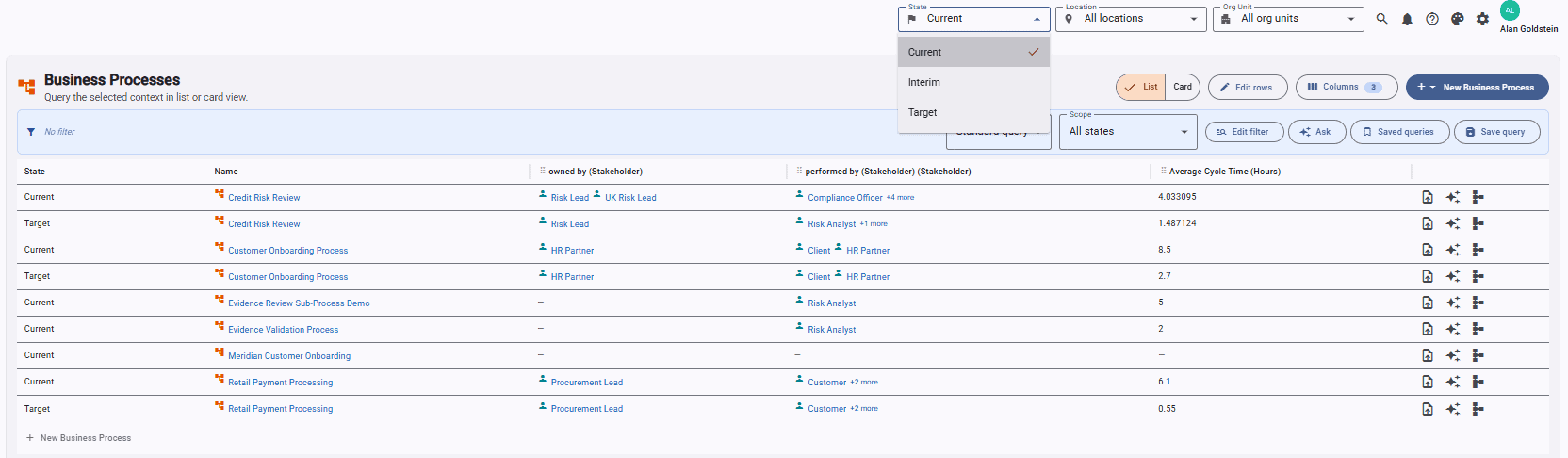
Current, Interim, and Target States for each process in GlobeArc (example data)
A practical implementation strategy involves three key steps:
- Start with a pilot: Select a smaller operational area or organizational unit to test the proposed process improvements before broader implementation.
- Define the transition from current state to target state: Map the steps required to move from the existing process to the standardized target process, identifying the interim states needed during the transition.
- Expand across the organization: Once the pilot successfully reaches the target state, begin rolling out the standardized process across other locations and organizational units.
While the target-state process may be consistent across the organization, the interim states can vary depending on each location's existing processes and operational requirements.
Each transition should also be connected to the initiatives and projects driving the change, with clear visibility into the individuals and organizational units involved at every stage.
9. Embed Standardized Processes Into Operational Systems
At Johnson Controls, we got the 24-plus processes down to two or three global processes, and those were programmed directly into the call center agents’ computer system. When an agent answered the phone, they could immediately see which company or customer was calling and which next step applied.
There was nothing that could really creep back in, because the call center’s process changed overall. Some of the steps agents used to go through weren’t even available anymore, because we had removed them once they were no longer needed.
Why Understanding Dependencies Between Business Processes Matters
Effective process standardization requires more than optimizing individual tasks. Organizations must also understand how processes connect, particularly where the output of one process becomes the input for another.
Early in my career, at a large financial services company, I submitted an order form for a software product the same way every other order form was submitted, through the usual internal web page. I didn’t hear back for weeks. When I followed up, I was told the process had changed and submissions through that page weren’t being looked at anymore.
Although the responsible team had intended to improve the process, the changes were implemented without fully accounting for the individuals and departments that depended on the existing workflow. As a result, requests submitted through the original portal were no longer reaching the intended recipients.
This example highlights an important consideration in business process standardization: improving one process without understanding its connections to other processes can unintentionally disrupt existing workflows.
Before implementing changes, organizations need visibility into process dependencies, including who uses each process, how information moves between activities, and which individuals or organizational units may be affected.
How Process Standardization Improves Organizational Agility
Standardizing processes reduces cost and complexity, but one of its biggest benefits is how quickly an organization can respond to change.
When COVID hit, the manufacturer I mentioned needed to quickly shift part of its manufacturing to a product it had never made before. Having processes standardized across the company, and related in a single system, made them quicker to market and more nimble. Without that, they wouldn’t have been able to make the change as quickly.
How GlobeArc Supports Process Standardization Across Locations
GlobeArc’s biggest differentiator for process standardization is Dynamic Contexts. Take a credit risk review process that is done differently in four different locations, and differently again between current state and target state. In GlobeArc, all of those versions are tied together. You can see not only the connections between the supporting architecture and the processes, but also the overlap and comparisons between the processes across all of those contexts.
Instead of hanging everything on a wall, you can choose the processes you want to compare and immediately see the overlay showing the differences. The same goes for the applications supporting each task, the Org Units involved, and the people responsible for each task in each process, all connected through Dynamic Contexts. Simulation and process analysis then let you compare current and target states on cost, duration, and capacity before you make the change.
To see how it works, Schedule a GlobeArc Demo
Frequently Asked Questions
What Is Business Process Standardization?
Process standardization means bringing multiple versions of the same process, often run differently across locations, Org Units, or clients, together into a common global process, while keeping only the differences that are truly required.
How do you choose which business process to standardize first?
Pick a process that isn’t too complex but is strategically important to the company. Avoid starting with something that is extremely complex and not strategically important.
How do you identify non-value-added process steps?
Classify each step as value to the customer, required by the business, or non-value-add, then remove the non-value-add steps. Regulatory or country-specific requirements that can’t be adjusted stay.
Should every location implement the same standardized process at once?
Usually not. Pilot in one smaller area first, then roll out more broadly. The target state can be the same everywhere, while each location follows its own interim state based on where it’s starting.
Why are application dependencies important in process standardization?
Two locations can follow the same steps but use different applications and data behind them, which means they aren’t really working the same way. You need to know what supports each task to truly standardize a process.