Process Standardization
Process Standardization
Process Standardization: Compare Processes Across Locations and Organizational Units
Most organizations want a common way of working, but the same process rarely runs identically everywhere. Locations, organizational units, and acquired companies adapt processes to local regulations, systems, and customers, and those differences often stay invisible until a standardization, transformation, or cost initiative exposes them.
GlobeArc combines Business Process Management and Enterprise Architecture in one connected repository, so process owners and managers can compare process variants against a global standard process, see which variations are deliberate and which are simply drift, and understand the people, applications, and organizational units behind each difference.
What is Process Standardization?
Process standardization is the work of defining a preferred global standard for how a process should run and then understanding how each location or organizational unit compares to it. The goal isn't to force every part of the organization into identical steps. It's to make differences visible, keep the variations that are genuinely needed, and reduce the ones that add cost, risk, or inconsistency.


Why Are Process Variations Difficult to See?
Process documentation is often created project by project, in different tools and formats, by different teams. When each location maintains its own diagrams, there is no reliable way to line them up against a standard or to see what sits behind the differences.
Common symptoms include:
- The same process documented differently in each location or organizational unit
- No agreed global standard process to compare against
- Local variations that no one can explain or justify
- Improvements made in one location that never reach the others
- Limited visibility into which applications and teams support each variant
- Standardization efforts that stall because the current state isn't clear
How Does GlobeArc Compare Processes Across Locations and Organizational Units?
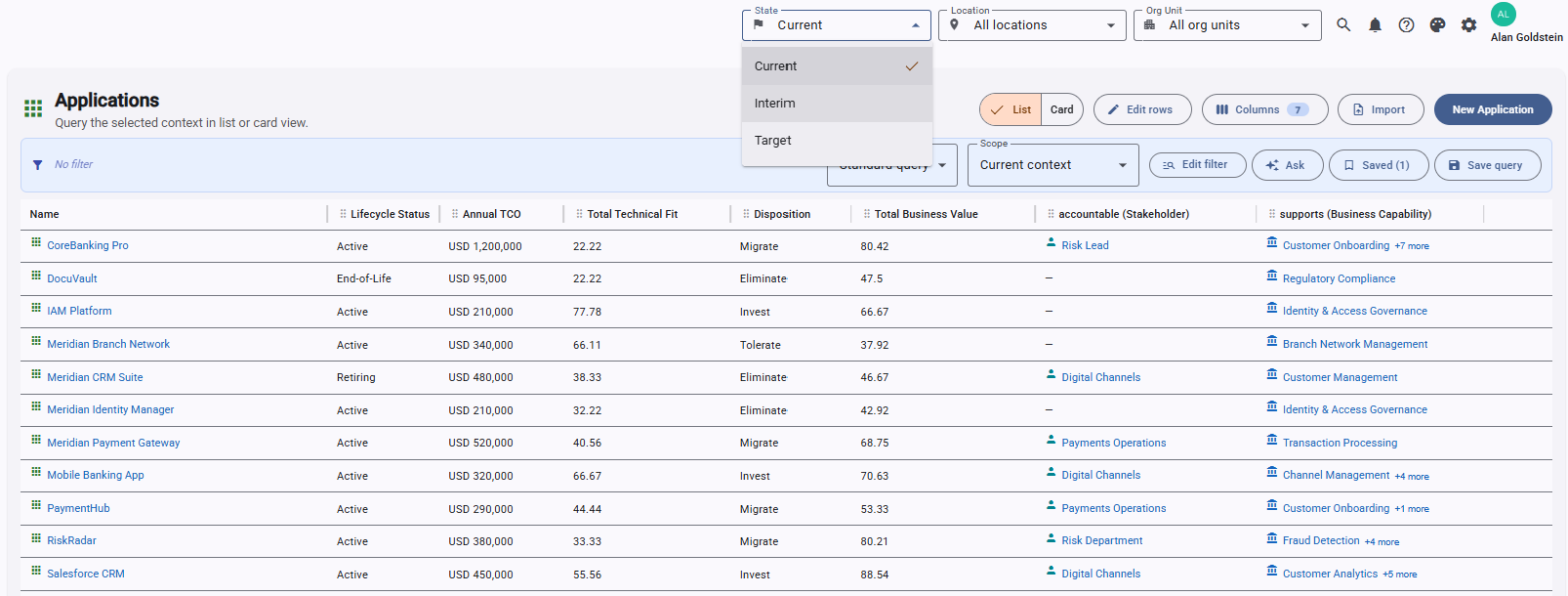
GlobeArc uses Dynamic Contexts to represent the same process across three dimensions: State (Current, Interim, or Target), Location, and Organizational Unit. A global standard process can be modeled once, and local variants can be represented where they legitimately differ. Hierarchical rollups and explicit exceptions keep local differences connected to the enterprise view rather than stored as separate, disconnected diagrams.
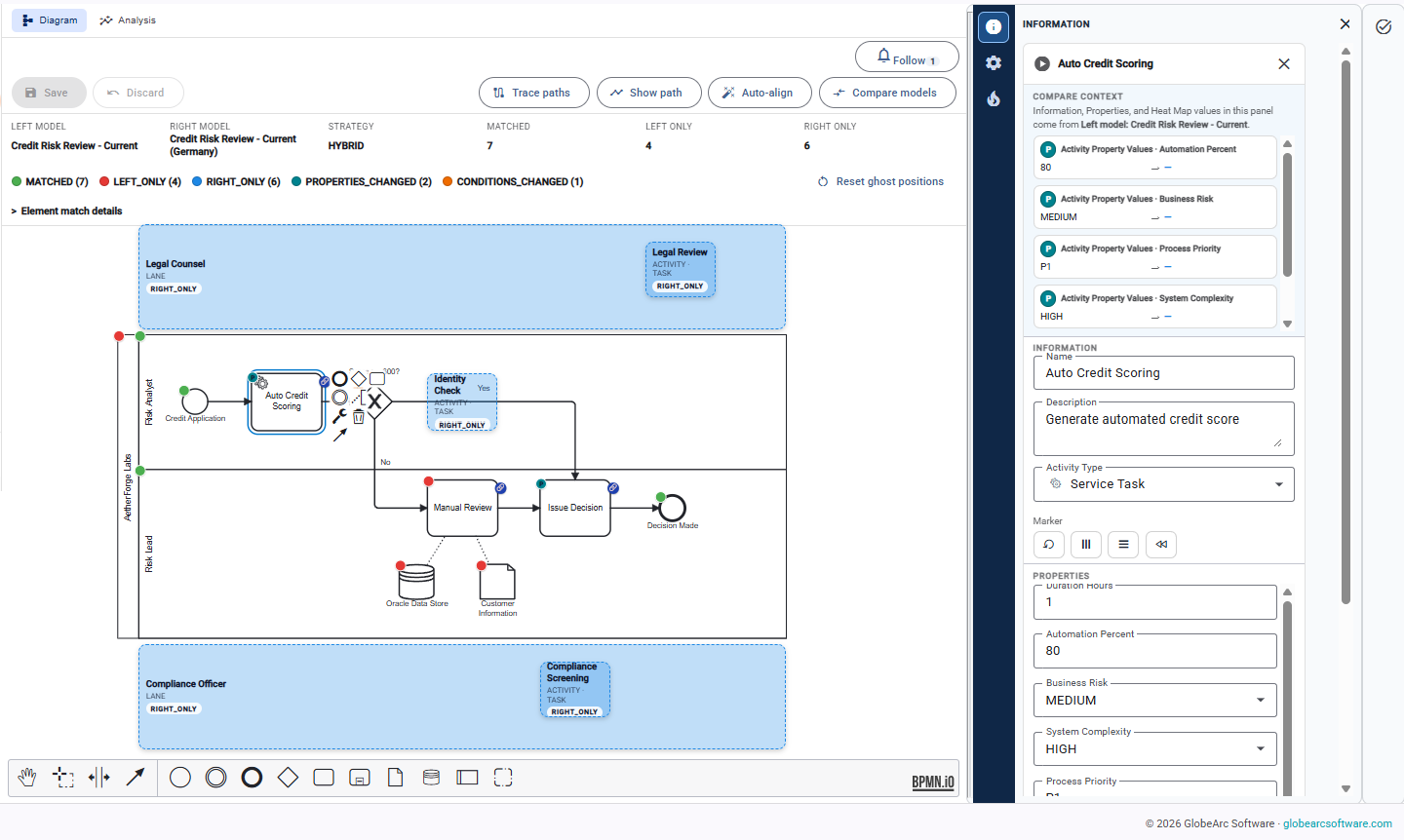
BPMN model comparison then shows how a variant differs from the standard, highlighting matched, renamed, changed, added, and removed process elements. Process owners can see exactly where a location departs from the global process instead of comparing diagrams side by side.
How Does Process Standardization Connect to Strategy and Cost?
With processes living in the same repository as capabilities, applications, strategy, and initiatives, standardization decisions can be connected to the business priorities and spend behind them. A process variant can be traced to the applications that support it and the capabilities it contributes to, helping leaders see which differences affect cost, risk, and customer-facing outcomes.
GlobeArc's shared heat-map engine also works on BPMN process models, so configured properties such as cycle time or cost can be viewed directly on the process to highlight where attention is needed.
How Do Current and Target States Support Process Standardization?
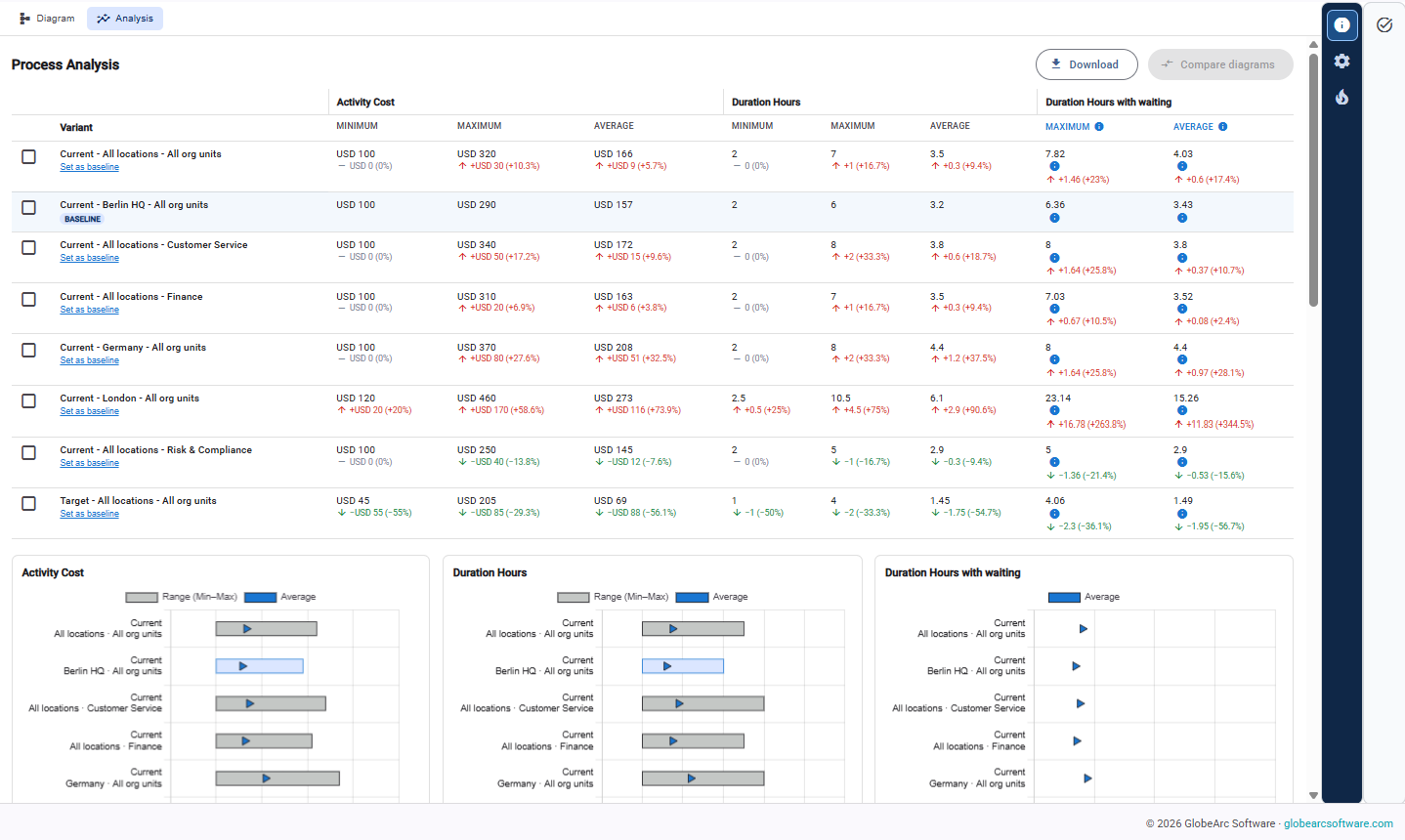
State works alongside Location and Org Unit, so teams can model both the local process in use today and the intended Target process for each location. Comparing states shows what needs to change for a location to move toward the standard, and Interim states can represent a phased rollout where locations adopt the standard at different times. Simulation and the Process Analysis view can also compare a local variant with the global standard on cost, duration, waiting time, and team capacity, showing the expected benefit of standardizing.
Where Process Standardization Fits Alongside Other Process Tools
GlobeArc isn’t a process mining tool or an engine for running day-to-day business operations. Its focus is documenting, connecting, and comparing process variants in the context of the wider enterprise, so teams can make better-supported standardization decisions and see how each variant connects to the applications, organizational units, and strategy around it.
Keep or Standardize
Which Differences Should Be Kept, and Which Should Be Standardized?
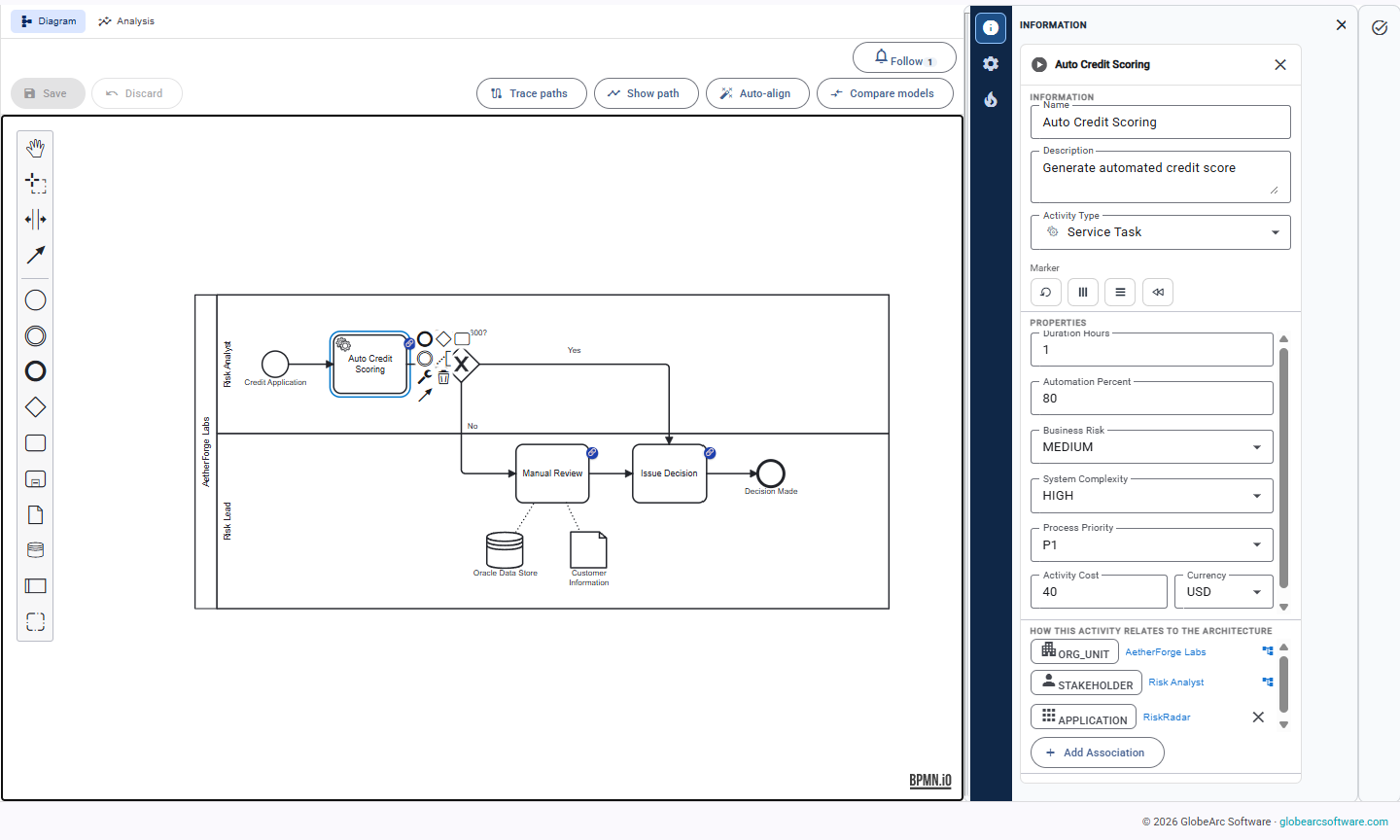
Not every variation is a problem. A difference may exist because of local regulation, a customer requirement, or a system that only one location uses. Because process lanes in GlobeArc resolve to real stakeholders, organizational units, and locations, and activities can link to applications and other repository objects, teams can investigate why a variant exists before deciding whether to standardize it.
Teams can investigate questions such as:
- Which locations follow the global standard process, and which don't?
- What steps are added, removed, or changed in each variant?
- Which applications support the process in each location?
- Which organizational units and roles perform each variant?
- Is a variation required, or has it simply drifted over time?
- What would change if a location adopted the standard?
What Other EA and BPM Solutions Support Process Standardization?
Process standardization often connects to AI-assisted modeling, Target-State planning, M&A integration, and strategy execution. Understanding how processes vary across locations and organizational units helps teams identify opportunities for consistency while supporting broader transformation initiatives.
Related solutions include:
- Transformation and Target-State Planning
- Application Modernization and Landscape Management
- Application Rationalization
- Mergers and Acquisitions Integration
- Strategy to Execution
- AI-Assisted Process Modeling


Who Uses GlobeArc for Process Standardization?
Process Owners and Process Managers typically lead the work, defining the global standard and deciding which local variations are justified. Business and Process Analysts document variants and investigate the differences, while Business Architects and Enterprise Architects connect the results to capabilities, applications, and Target-State planning.
See Your Process Variants Side by Side
Request a demo to compare a global standard process with its local variants, see what differs and why, and understand the people, applications, and capabilities connected to each difference.
We’re here to help you bring clarity to complexity.