
C-Level Leaders
Connected Decision Intelligence
C-Level Leaders: Connected Decision Intelligence Across Business and Technology
Major enterprise decisions rarely belong to one department or one discipline. Investment, transformation, risk, M&A, and strategic change cut across business processes, capabilities, applications, technology, organizational structures, and financial considerations. GlobeArc combines Enterprise Architecture and Business Process Management in one connected platform so executives can understand those relationships before committing to consequential decisions.
For executives, the value of combining enterprise architecture and business process management isn’t more architecture detail. It is reliable decision intelligence that connects the structure of the enterprise with the processes that make it operate, helping leadership understand what sits behind a recommendation, what a proposed change affects, and whether strategy, investment, and execution remain aligned.


Trust the Numbers
Can Executives Trust the Numbers Behind a Decision?
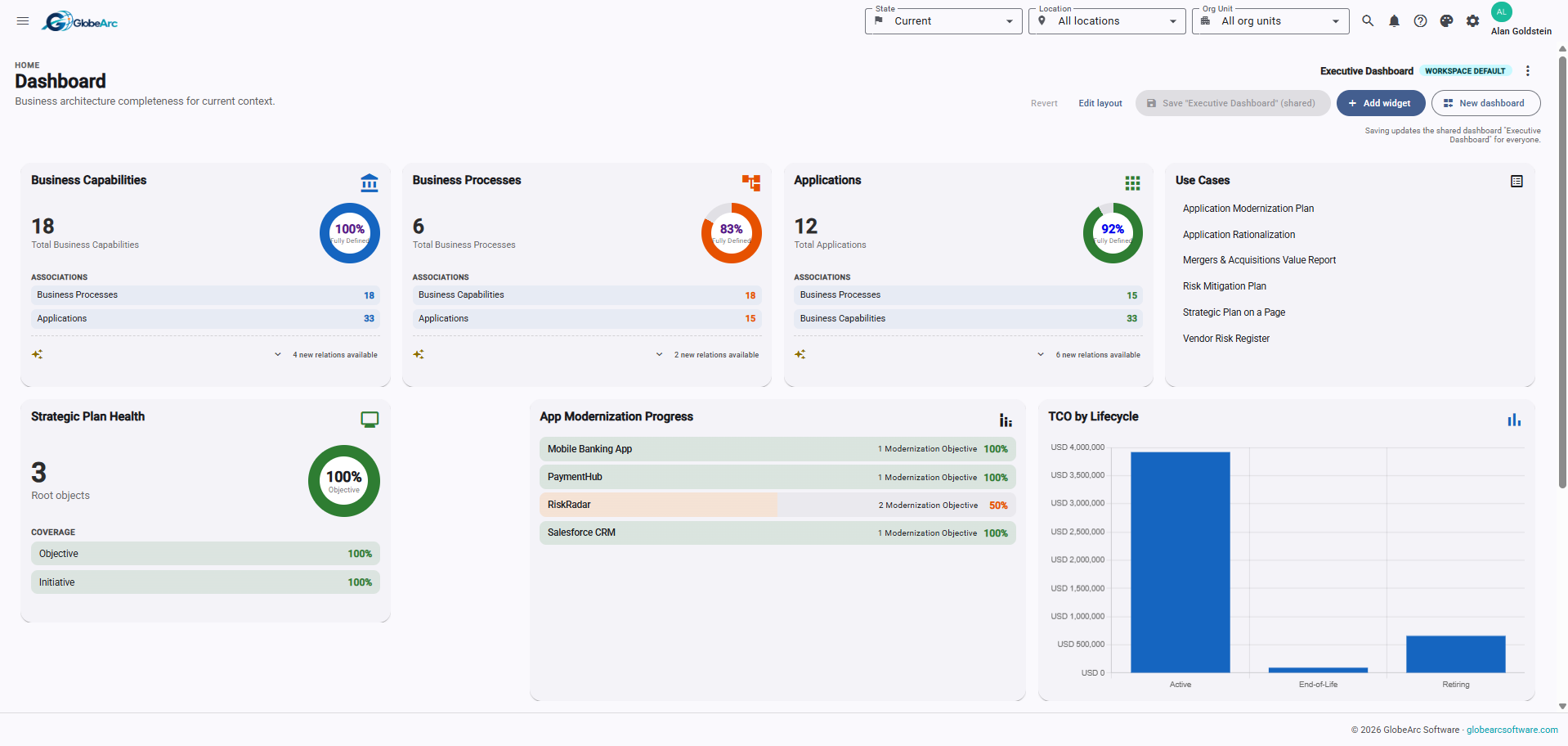
Executives can have greater confidence in a decision when important figures can be traced to the information and relationships behind them. GlobeArc connects calculated values, queries, reports, and visual analysis to the underlying business and technology context rather than presenting numbers in isolation.
Depending on the decision, leaders can investigate customer-provided cost and budget information, application value, technical fit, TCO, customer-defined M&A synergy values, capability relationships, operational dependencies, and other configured information. This makes it easier to understand what supports a recommendation and where additional investigation may be warranted.
Enterprise Decision Intelligence Across the Organization
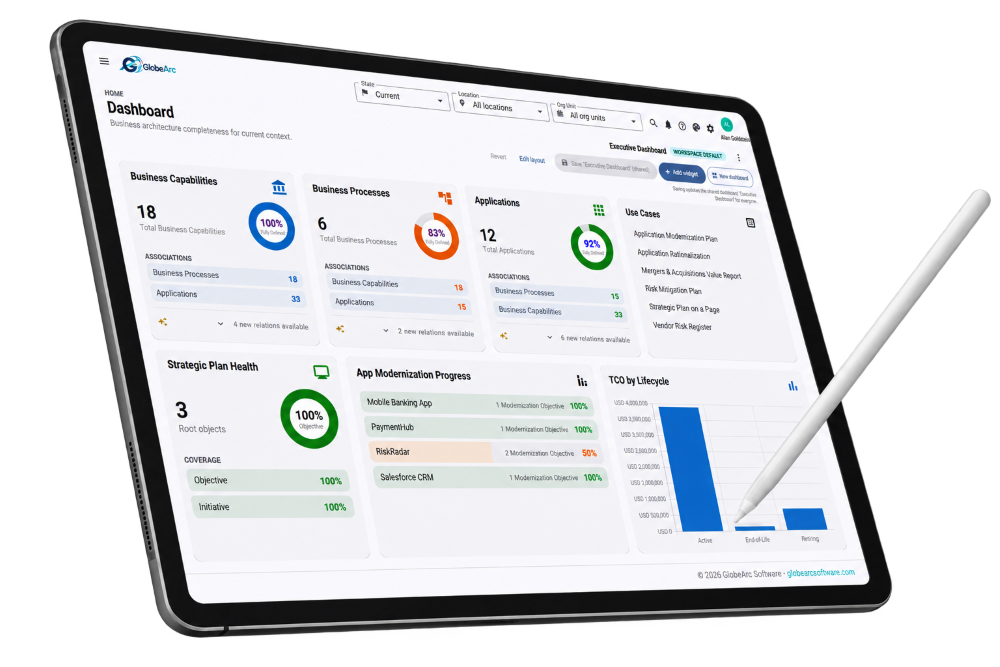
GlobeArc helps executives see relationships that are often hidden when business and IT maintain separate views of the organization. Enterprise Architecture provides structural context, Business Process Management adds operational context, and the shared repository connects both to strategy and transformation.
That connected view can surface:
- Dependencies that cross departmental boundaries
- Decisions with consequences beyond the team proposing them
- Gaps between strategic priorities and funded activity
- Areas where technology and operational change intersect
- Organizational or geographic differences affecting transformation
- Concentrations of cost, dependency, or exposure that require closer attention
The result is broader executive visibility without requiring leaders to work through disconnected architecture diagrams, process models, and departmental reports.
How Can Executives Make Better Technology Investment Decisions?
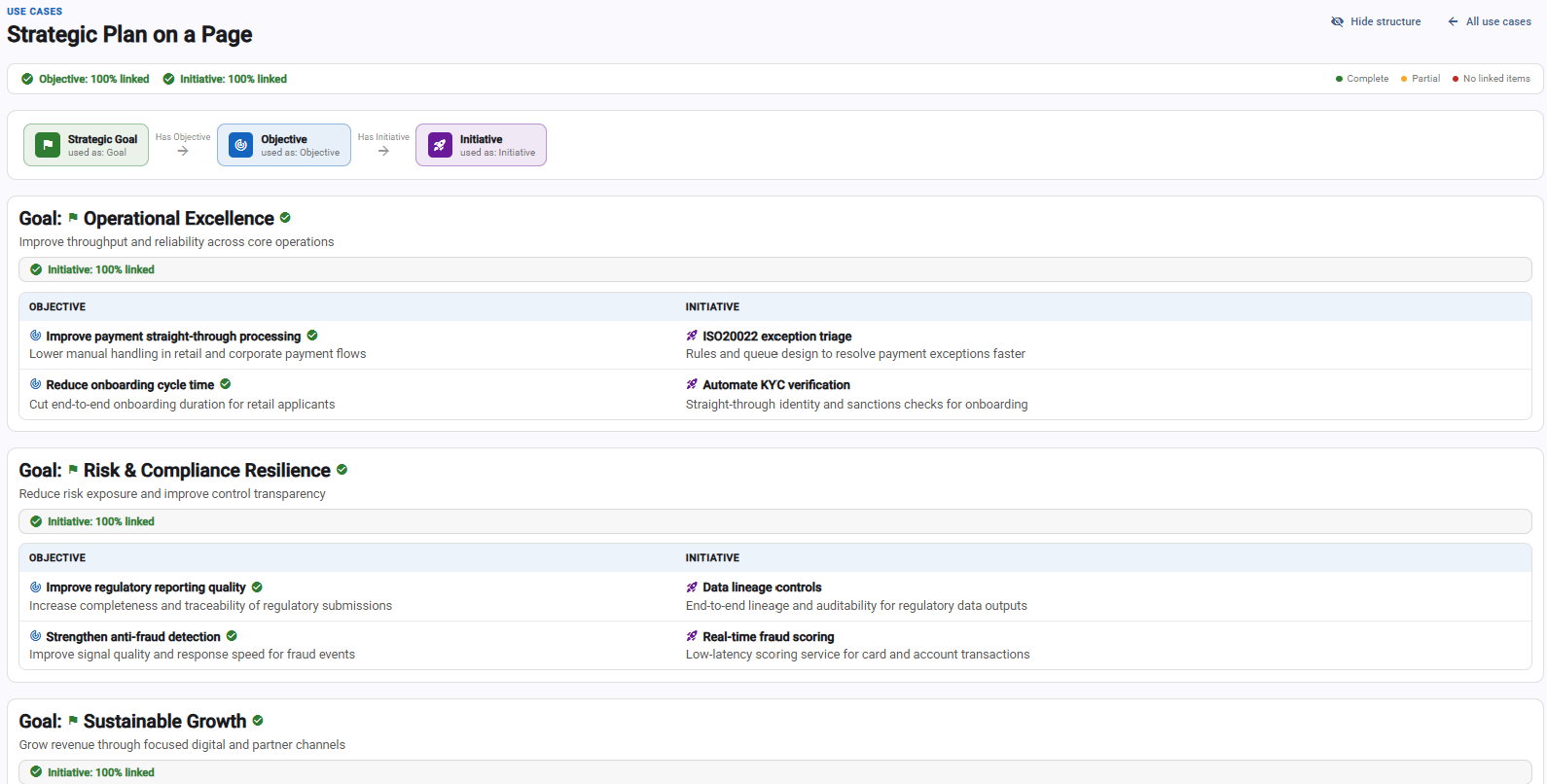
Executives can make better-supported technology investment decisions by seeing what an investment is intended to achieve and what parts of the enterprise it is expected to change. GlobeArc connects strategic goals, objectives, initiatives, projects, capabilities, processes, applications, and organizational context so investments can be examined from both structural and operational perspectives.
This gives leadership stronger evidence when comparing competing investments, questioning work with weak strategic alignment, or deciding whether continued funding still supports current priorities.
Understand the Financial Implications of Enterprise Change
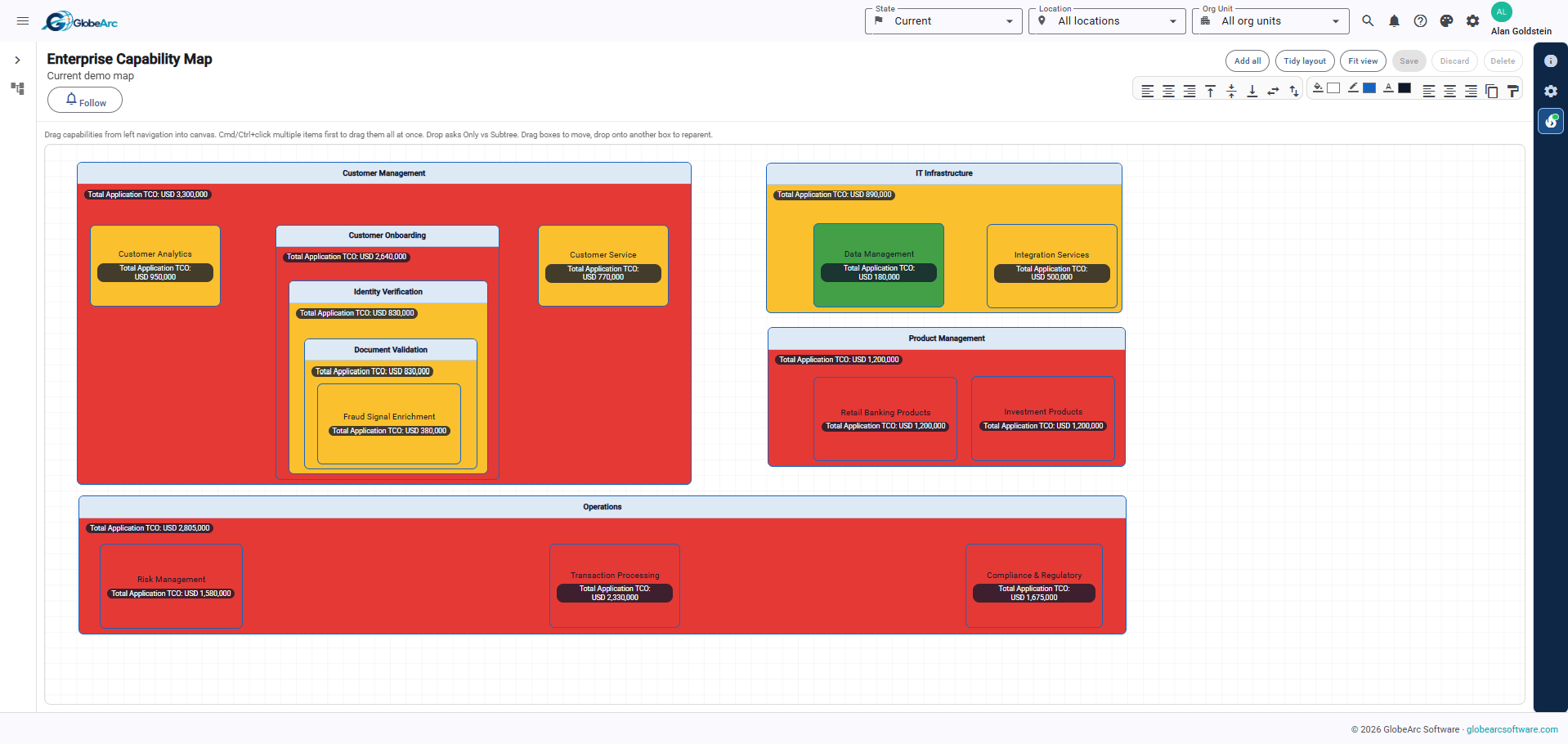
Financial information becomes more useful when leadership can see the business and technology relationships surrounding it. GlobeArc can connect customer-provided financial information to the applications, initiatives, capabilities, vendors, and organizational areas involved in a decision.
That context helps executives investigate questions such as:
- Which business areas depend on an application being considered for retirement?
- Where does application overlap suggest an opportunity for consolidation?
- Which capabilities are associated with significant technology investment?
- What dependencies could affect an expected financial outcome?
- Where does vendor concentration create broader business exposure?
- How does the proposed Target state alter the current cost or technology picture?
GlobeArc provides decision context around financial information rather than replacing financial planning, accounting, or valuation systems.
How Does GlobeArc Connect Strategy to Execution?
GlobeArc connects strategy to execution by tracing strategic intent into the initiatives, projects, capabilities, processes, and organizational change intended to deliver it. Leaders can follow those relationships in either direction, from a strategic priority into execution or from funded work back to the reason it exists.
This traceability helps reveal where strategic intent and execution may be drifting apart. Executives can identify work with weak strategic relationships, priorities with limited delivery activity, overlapping investments, ownership gaps, and operational dependencies that may affect delivery.

How Can Executives See the Impact of Transformation Decisions?
Executives learn the impact of transformation decisions by examining the business, process, technology, and organizational relationships surrounding a proposed change. GlobeArc connects applications, processes, capabilities, integrations, organizational units, locations, stakeholders, and transformation states so leadership can understand whether a change is relatively contained or has wider consequences.
This provides stronger business transformation visibility before major decisions move forward. A technology change that appears straightforward in isolation may affect critical processes, multiple business areas, or other systems once its relationships are examined. For process changes, simulation can show the expected effect on cost, duration, and team capacity before the change is approved.

M&A Synergy and Executive Decision Support
GlobeArc helps executives examine the connected enterprise context behind M&A integration decisions. Two application estates can be brought into a common view while retaining organizational context, making overlap, dependencies, disposition choices, and the intended post-merger Target state easier to investigate.
Customer-defined synergy values can also be connected to the initiatives expected to realize them and tracked through Identified, Committed, In Progress, and Realized status. This gives leadership greater visibility into how expected synergy connects to actual change.

Enterprise Risk Visibility Across Business and Technology
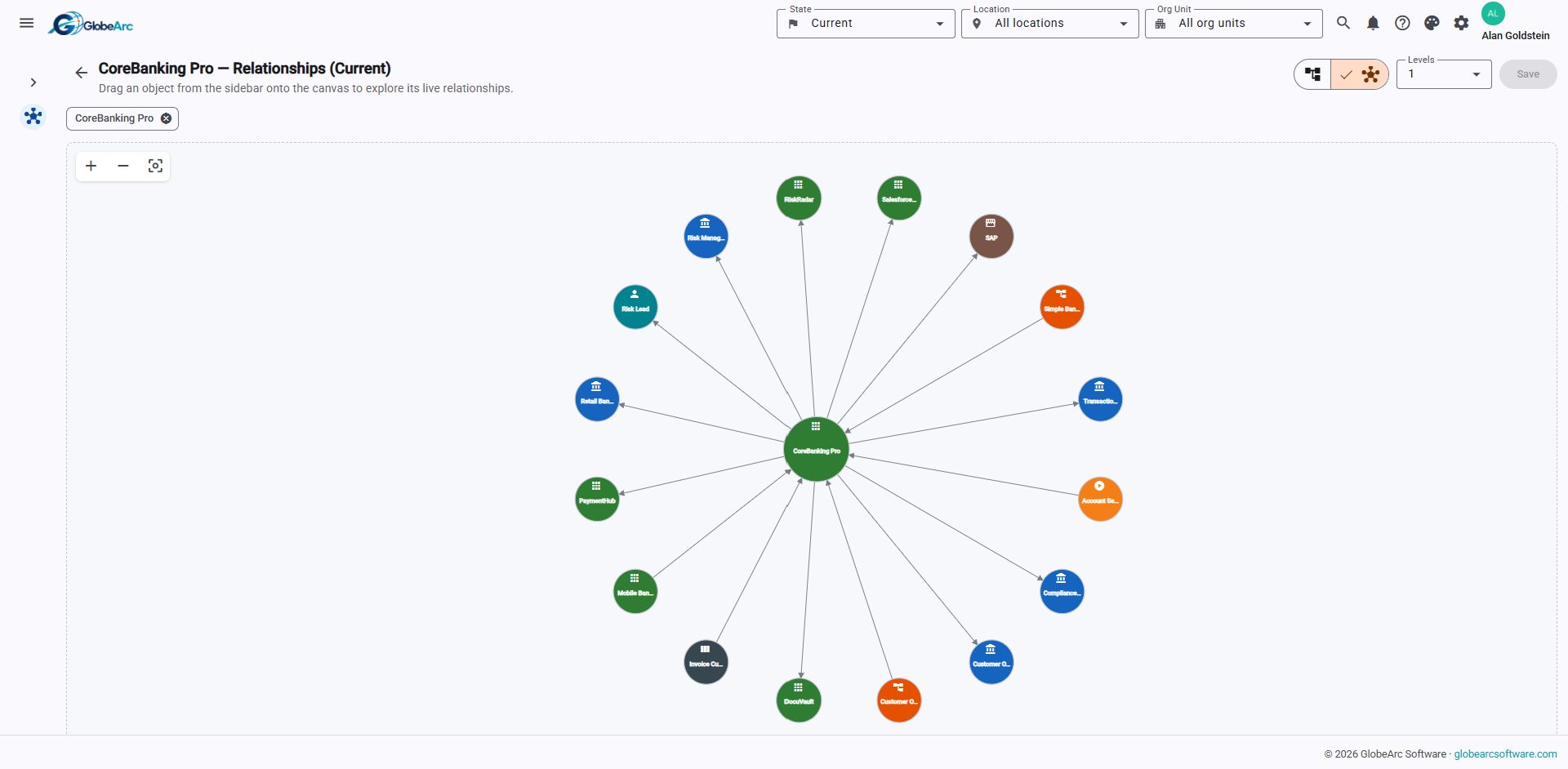
GlobeArc helps leaders understand how far a technology or operational dependency may reach across the organization. Because Enterprise Architecture and Business Process Management share the same foundation, executives can investigate both the structural and operational context around an area of concern.
For example, a technology vendor can be traced through applications into business capabilities, processes, contracts, organizational units, and locations. This helps leadership distinguish an isolated dependency from one with broader enterprise consequences.

Strengthen Accountability Across Departments
Cross-functional transformation often becomes difficult when ownership is fragmented across business and IT. GlobeArc connects stakeholders, organizational units, initiatives, projects, capabilities, processes, and other enterprise information so leaders can see the organizational context surrounding important change.
That visibility can help executives understand where responsibility sits, where several groups share involvement, and where important work lacks a clear connection to accountable parts of the organization.
How Does Connected Information Reduce Decision Blindness?
Connected information reduces decision blindness by exposing the relationships, assumptions, and dependencies that sit behind a recommendation. Instead of viewing strategy, process, architecture, technology, and transformation as separate subjects, GlobeArc brings them into a common decision context.
Executives can use that evidence to challenge assumptions earlier, investigate consequences beyond the immediate proposal, and make faster, better-supported decisions with a clearer understanding of what the organization is committing to.
Current and Target State Visibility for Transformation
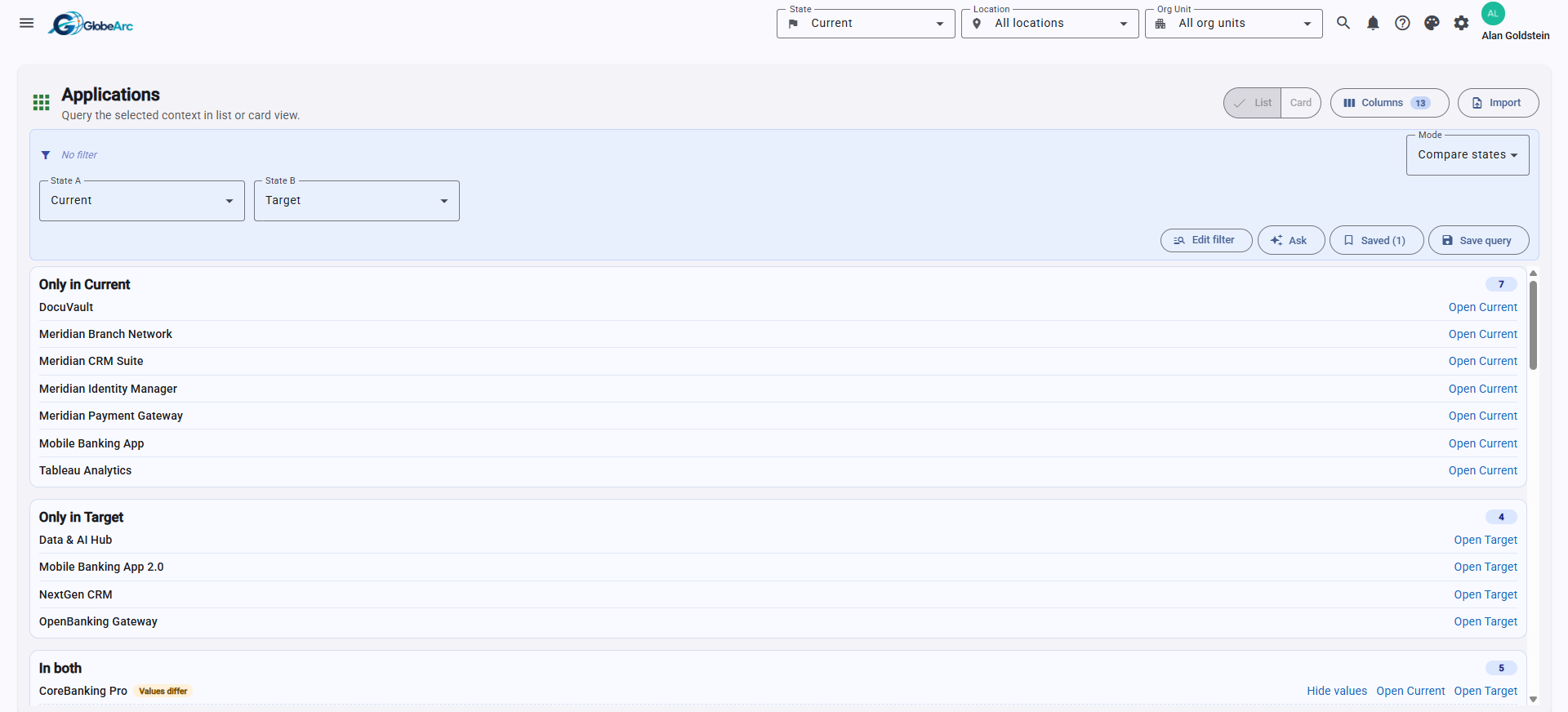
Current, Interim, and Target states help leadership understand where the enterprise is today, where it intends to go, and what changes between those points. Because these states are part of GlobeArc's connected repository context, teams can compare transformation without maintaining an entirely separate future-state picture.
Executives can use this view to examine:
- Elements being removed or introduced
- Relationships changing between states
- Property-level differences
- Interim conditions that must exist before the Target state is reached
- Location variations in the transformation
- Organizational unit differences that affect implementation
This gives leaders a more concrete basis for discussing transformation confidence, dependencies, and the implications of changing direction.

Why Should Business Leaders Care About Enterprise Architecture and Business Process Management Together?
Business leaders benefit when Enterprise Architecture and Business Process Management are connected because major decisions affect both how the organization is structured and how it operates. Architecture alone may show systems, capabilities, and dependencies, while process information shows how work flows through people, applications, and organizational areas.
GlobeArc brings those perspectives together in one platform. For executives, that means strategic investment, transformation, M&A, operational risk, and technology decisions can be considered against a more complete picture of the enterprise.
Better Context for High-Impact Enterprise Decisions
GlobeArc gives C-Level leaders a connected view of the information behind major enterprise decisions. By combining Enterprise Architecture and Business Process Management from the foundation of the platform, it connects strategic intent, operational reality, technology, financial context, organizational responsibility, and planned change.
The result is executive decision support built around a simple requirement: understand what sits behind the decision, what it affects, and whether the organization has the evidence needed to move forward with confidence.
We’re here to help you bring clarity to complexity.