
Vendor Concentration and Risk
Risk Management
Technology Vendor Risk Management for Concentration and Dependency
Technology vendor risk management becomes more useful when organizations can see what a vendor dependency actually puts at risk. GlobeArc connects vendors to applications, business capabilities, processes, organizational context, contracts, risks, and mitigation activity so teams can identify where technology dependency is concentrated and understand the potential business exposure behind it.
The focus is not generic third-party compliance. GlobeArc helps answer a more specific architecture and operational-risk question: where are we too dependent on one technology vendor, and what could be affected if that dependency becomes unavailable, uneconomic, unsupported, or otherwise problematic? That connected view helps teams identify single points of failure, investigate concentration, and prioritize mitigation.


What is Technology Vendor Concentration Risk?
Technology vendor concentration risk occurs when important applications, capabilities, processes, or organizational activities depend disproportionately on one technology vendor. The greater the concentration around business-critical areas, the more significant the potential operational impact of disruption or deterioration in that vendor relationship.
Concentration isn't inherently a problem. Standardizing on a strategic vendor can reduce complexity and cost. Risk emerges when the organization doesn't understand the extent of the dependency, has limited alternatives, or can't clearly see which parts of the business would be affected if the vendor became unavailable.
Why is Technology Vendor Risk Difficult to See?
Vendor inventories rarely show the full business impact of a technology dependency. Procurement may know the supplier and contract, application teams may know the systems involved, architects may understand capability coverage, and operational teams may know the affected processes, but those perspectives are often maintained separately.
That fragmentation makes seemingly simple questions difficult to answer:
- How many applications depend on this vendor?
- Which capabilities rely on those applications?
- Which business processes could be affected?
- Which organizational units carry the exposure?
- How much contract exposure is concentrated with the vendor?
- Is the vendor a single point of failure?
- What mitigation is planned?
- Who owns the response?
GlobeArc connects those perspectives so vendor risk can be investigated as a dependency problem rather than another isolated register.
Who Usually Owns Technology Vendor Risk Management?
Operational Risk and Third-Party Risk teams commonly own the risk question, while enterprise architects provide the application, capability, process, and dependency context needed to understand exposure. Procurement, technology leaders, application owners, process owners, and business stakeholders may contribute contract information, criticality assessments, mitigation plans, and operational context.
The connected architecture is especially useful where no single function has the complete picture. Risk teams can understand business exposure, while architects can see how technology concentration affects the wider enterprise.
How Do You Identify Technology Vendor Dependencies?
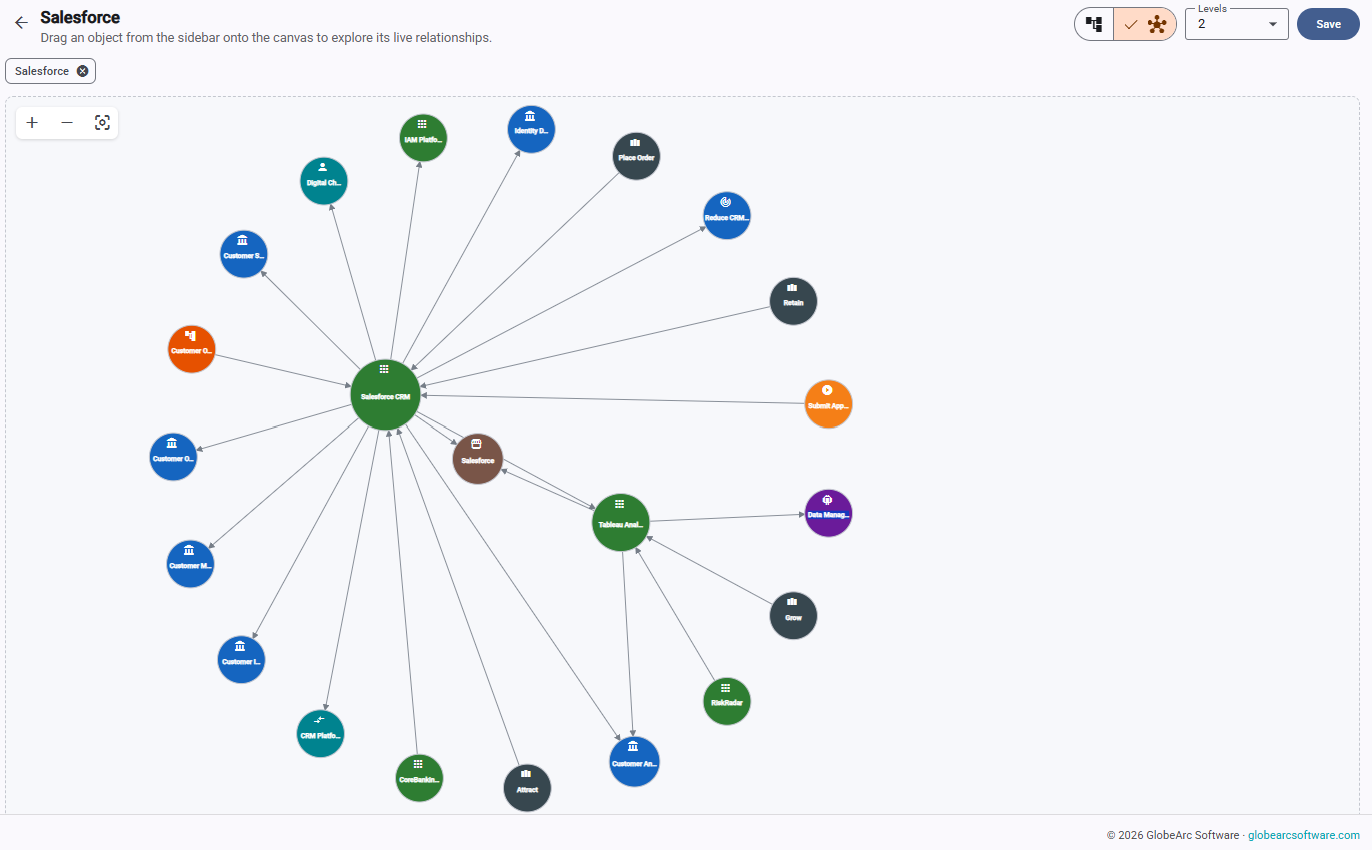
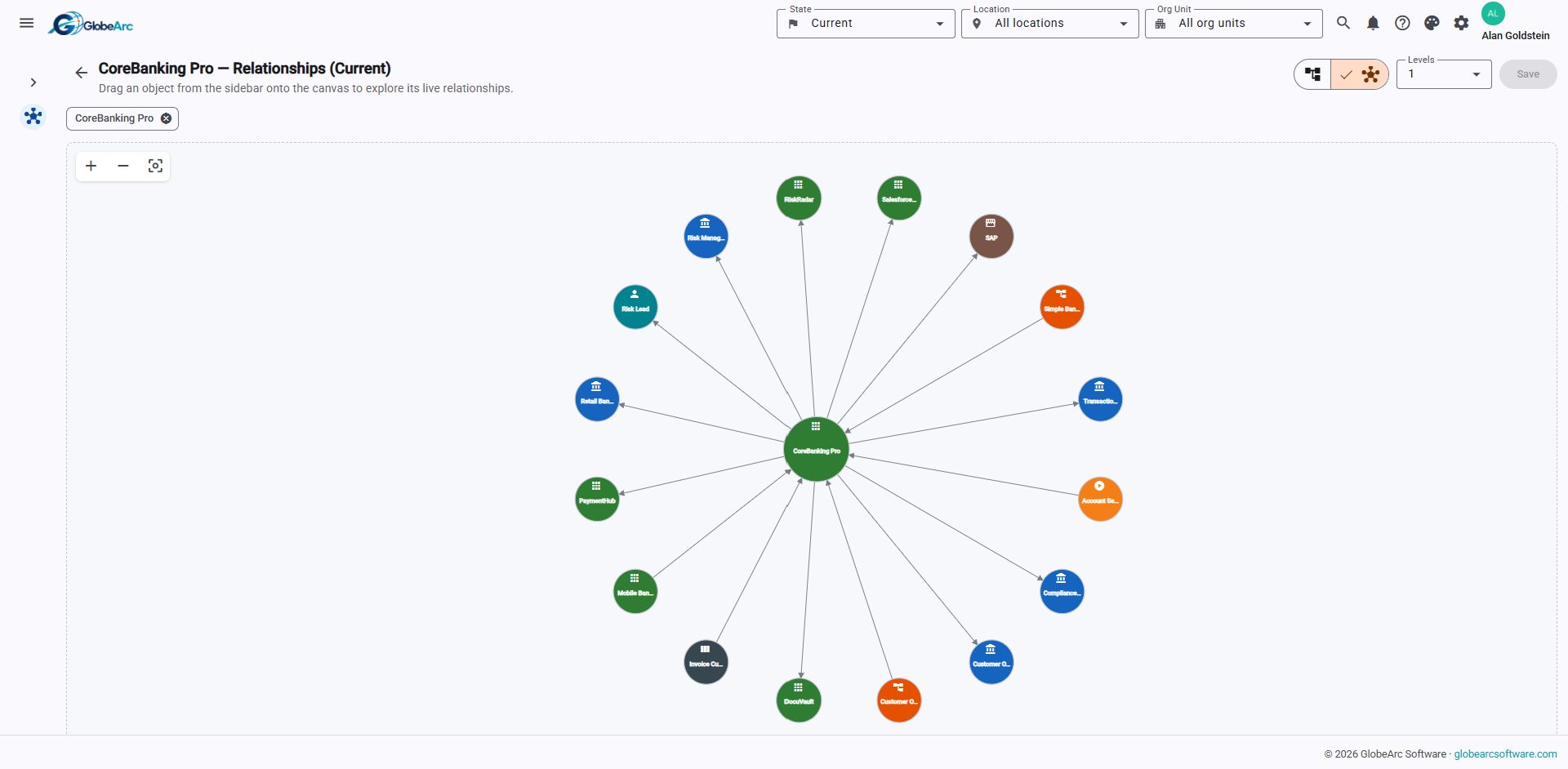
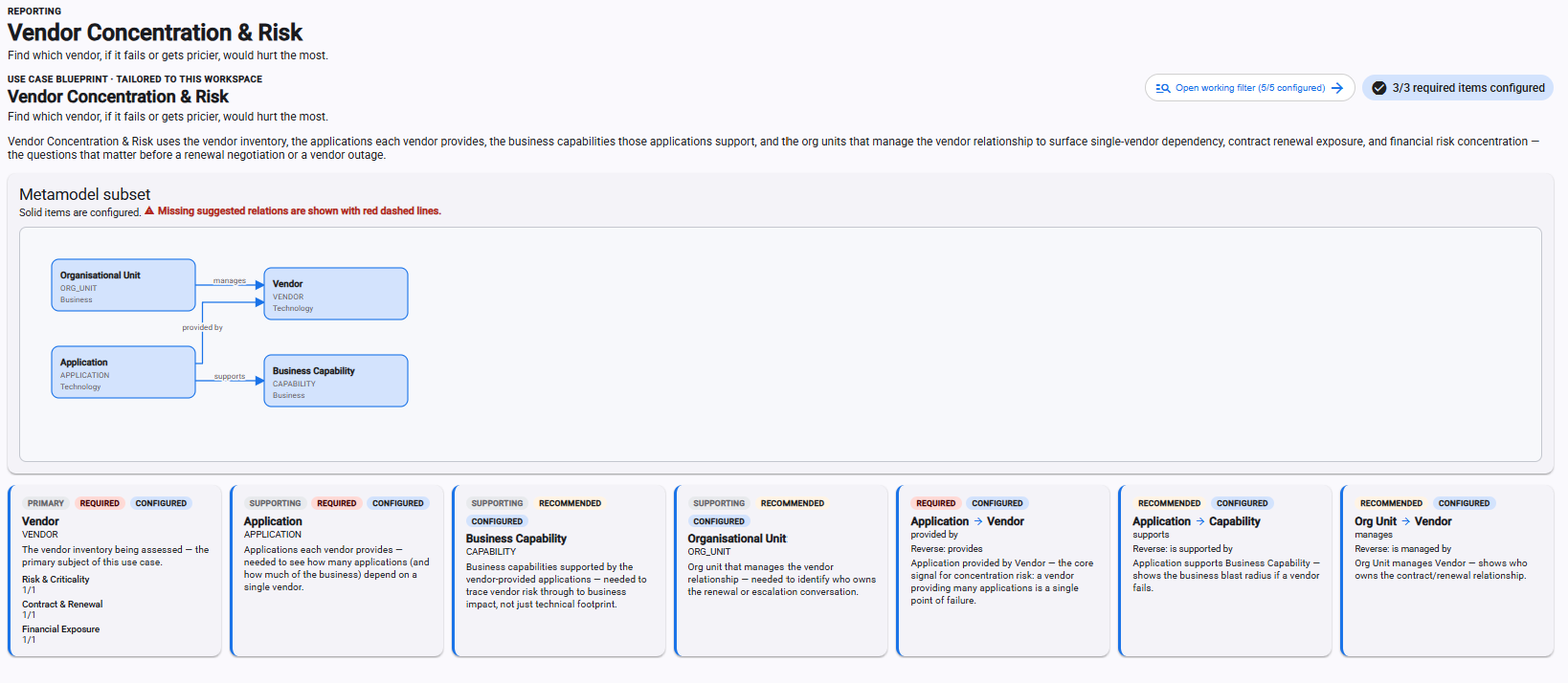
Vendor dependencies can be identified by tracing the relationships from a vendor through the applications it supplies or supports and into the business architecture those applications enable. This creates a path from the technology supplier to the parts of the organization that could be affected by that dependency.
A vendor can be examined in relation to:
- Applications
- Business capabilities
- Business processes
- Organizational units
- Contracts
- Locations
- Risks
- Mitigation activity
This turns a vendor record into a connected view of dependency and exposure.
How Do You Identify Vendor Concentration?
Concentration becomes visible when vendor relationships are analyzed across the application portfolio and the business areas those applications support. A vendor associated with many applications may warrant attention, but the number of applications alone doesn't determine the level of risk.
The more important question is what those applications support. A smaller vendor dependency concentrated around critical capabilities or processes may deserve more attention than a larger vendor relationship supporting less critical areas.
Teams can investigate measures such as:
- Number of applications associated with a vendor
- Capabilities exposed through those applications
- Processes connected to the dependency
- Organizational areas affected
- Contract exposure
- Business criticality
- Configured risk indicators
- Geographic or organizational unit concentration
The result is a more useful picture than a vendor count alone.

Which Applications Depend on a Technology Vendor?
Connected vendor and application relationships show which systems are associated with a particular supplier. Teams can start with the vendor and trace outward to the applications that create the technology dependency.
From there, the investigation can continue into the rest of the architecture. An application isn't treated as the end of the analysis because the business impact depends on what that application supports and where it is used.
This makes it possible to move from "we rely heavily on this vendor" to a more precise understanding of which systems create that reliance.

Which Business Capabilities Are Exposed When a Technology Vendor Fails?
Capability exposure can be traced through the applications that depend on a vendor and the business capabilities those applications support. This shows which parts of the business could be affected if the underlying technology dependency were disrupted.
The relationship can be followed as:
Vendor → Application → Business Capability
That connection helps risk and architecture teams distinguish between vendor concentration and business-critical concentration. It also gives decision-makers a clearer explanation of why a technology dependency matters beyond its technical footprint.

Which Business Processes Are Exposed to Vendor Dependency?
Process exposure can be investigated by following connected architecture relationships beyond applications and capabilities into the processes that rely on them. This helps teams understand where a vendor issue could affect business operations rather than stopping the analysis at the application layer.
A connected path can extend across:
Vendor → Application → Capability → Process → Organizational Unit
That wider view is particularly useful for Operational Risk and Process Owners who need to understand the potential business impact of technology disruption.

How Do You Identify Critical Technology Vendors?
Critical vendors can be identified by combining vendor information with the applications, capabilities, processes, organizational areas, contracts, and risk characteristics connected to them. This provides a broader basis for prioritization than simply labeling the organization's largest suppliers as critical.
A vendor may deserve closer attention because it supports a critical application, enables an important capability, creates a single point of failure, or has concentrated exposure across several areas at once.
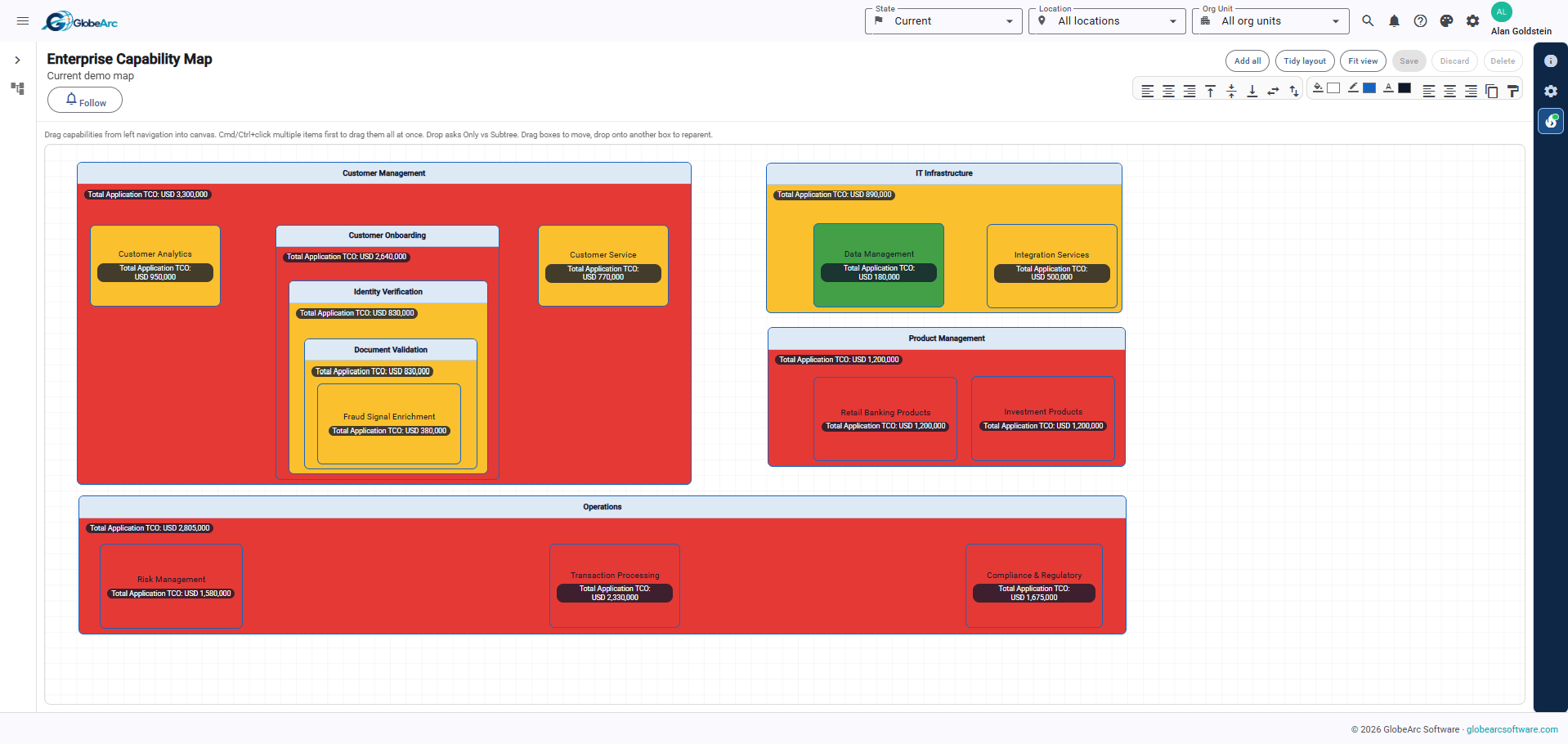
GlobeArc's shared heat-map engine can also help teams visualize configured risk or exposure information across Business Capability Maps, Value Streams, BPMN process models, and Application Landscape Models.
How Does Contract Concentration Affect Technology Vendor Risk?
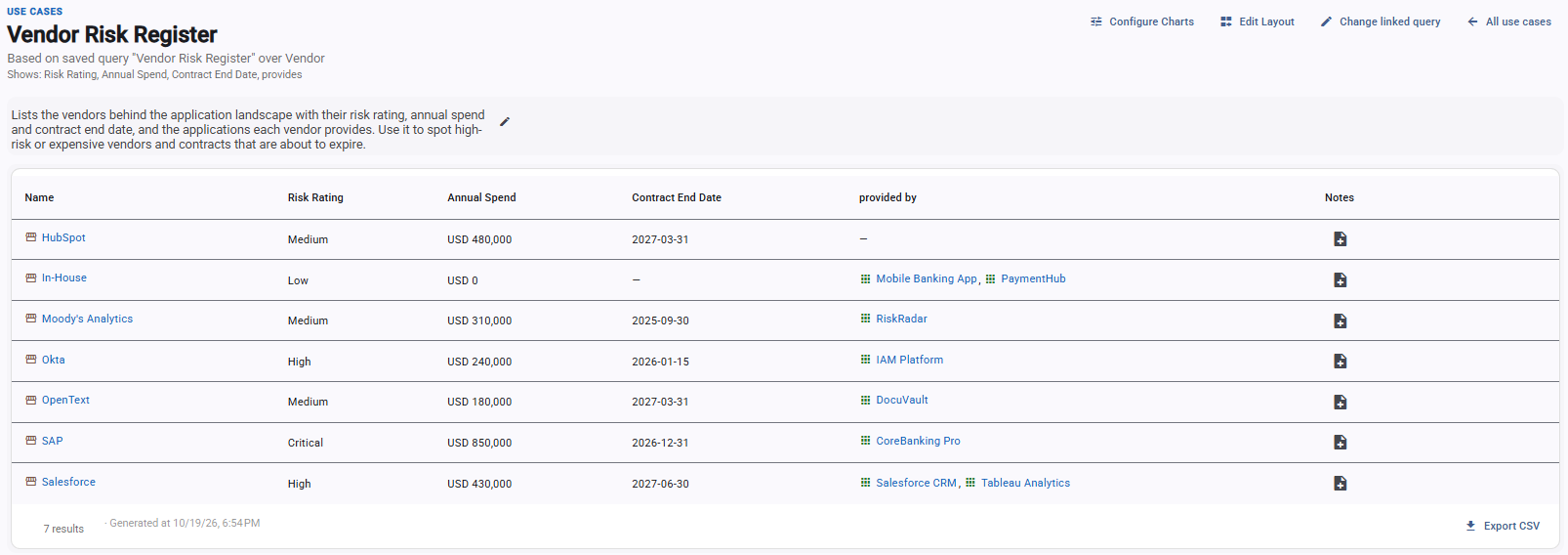
Contract information adds commercial exposure to the technology dependency picture. A vendor supporting multiple applications or important capabilities may represent a different level of concern when significant contract value, renewal constraints, or other commercial dependencies are concentrated around the same relationship.
GlobeArc can connect Vendor and Contract information with applications and the wider architecture, allowing teams to examine contract exposure alongside technology concentration.
This can help teams investigate whether:
- Multiple important applications depend on the same vendor
- Significant contract exposure is concentrated with that supplier
- Critical business areas depend on the contracted technology
- Contract and technology concentration reinforce one another
- Mitigation should be prioritized before future contract decisions
GlobeArc provides the connected context for that analysis rather than replacing procurement or contract-management systems.

How Do You Identify Single Points of Failure?
Single points of failure become easier to investigate when teams can see where an important business area has concentrated dependency and limited alternatives. The objective is to find dependencies whose disruption could affect important capabilities or processes without an obvious substitute.
Teams can examine the architecture for questions such as:
- Does a critical capability depend heavily on applications from one vendor?
- Does an important process rely on a concentrated technology dependency?
- Is the same vendor present across several connected business areas?
- Are multiple applications dependent on the same supplier?
- Is there an alternative application or supplier represented in the Target state?
- Has mitigation been defined for the exposure?
GlobeArc provides the relationship context needed to investigate these questions.
How Does the Vendor Risk Register Support Prioritization?
The Vendor Risk Register gives teams a structured view of vendor-related risks so they can review and prioritize concerns alongside the architecture context behind them. Rather than leaving the risk disconnected from the technology estate, teams can relate vendor risk information to the areas potentially exposed.
This helps risk teams move from a general statement such as "Vendor A represents a concentration risk" toward a more useful understanding of why the risk matters, which parts of the organization are involved, and what needs further investigation.
The register supports analysis and prioritization.

How Does GlobeArc Support Vendor Risk Mitigation?
Mitigation can be connected to the identified risk so teams can see what response is planned, who owns it, and its current status. The Risk Mitigation Plan provides a structured way to keep the response connected to the exposure it is intended to address.
Mitigation might involve actions such as:
- Reducing reliance on a single technology
- Introducing an alternative supplier
- Moving applications to another platform
- Changing the Target architecture
- Diversifying capability support
- Addressing a contract dependency
- Reducing exposure within a critical process
- Establishing another appropriate resilience measure
GlobeArc provides the architecture context and mitigation structure. The actual treatment strategy remains an organizational risk decision.
How Can Heat Maps Help Prioritize Vendor Risk?
Heat maps can expose where configured risk and concentration characteristics are distributed across the architecture. The same analytical engine can be applied across multiple model types, helping teams examine vendor-related exposure from different business and technology perspectives. Heat maps help direct attention toward areas requiring investigation.
Depending on the configured data, teams can use visual analysis to investigate areas such as:
- Application concentration
- Cost exposure
- Capability exposure
- Process exposure
- Vendor criticality
- Risk classifications
- Organizational concentration
How Does Scenario Analysis Help Evaluate Vendor Risk?
Current, Interim, and Target architecture states can be used to examine how vendor exposure changes under different planned architecture conditions. Teams can compare the existing dependency picture with a proposed future state to see whether mitigation actually reduces concentration.
For example, a team could represent a Target state in which applications supporting an important capability are no longer concentrated around the same vendor. Compare States can then help identify the structural and property changes between the Current and Target architecture.
How Can Vendor Risk Be Viewed Across Locations and Organizational Units?
Location and Org Unit contexts allow teams to examine how technology dependencies vary across different parts of the organization. A vendor may create significant concentration in one organizational unit or location while representing a much smaller dependency elsewhere.
Hierarchical context also helps teams roll information up to broader organizational or geographic levels. This makes it easier to understand whether a vendor issue is localized or represents a wider enterprise exposure.
That context can be particularly useful for global organizations where supplier dependency isn't distributed evenly.
How Can Alternative Supplier Planning Reduce Vendor Concentration?
Alternative supplier planning can reduce concentration by identifying where the Target architecture should introduce greater technology or supplier diversity. The starting point is understanding which capabilities, processes, and applications currently depend on the concentrated vendor.
Teams can then assess where an alternative supplier, application, platform, or architecture approach could reduce that exposure. Current, Interim, and Target states provide a way to represent how the architecture would change as mitigation is introduced.
GlobeArc helps teams model the dependency being addressed and understand how a proposed alternative would change the architecture.
How Does Vendor Concentration Relate to Security and Operational Risk?
Technology vendor concentration can create both security and operational concerns because a shared dependency may expose multiple applications and business areas to the same underlying event. The nature of that event could range from service disruption and technology obsolescence to a security incident affecting a critical supplier.
GlobeArc helps teams understand the architecture and dependency context around those concerns. Operational Risk teams can investigate business exposure and mitigation in the same connected view.
These are related but distinct concerns.
What Data is Needed for Vendor Concentration Analysis?
A useful vendor concentration assessment needs enough relationship data to connect suppliers to the technology and business areas that depend on them. Vendor and contract information can be added to GlobeArc's configurable metamodel when those concepts aren't already present in the workspace.
Useful inputs can include:
- Vendor information
- Application inventory
- Vendor-to-application relationships
- Business capabilities
- Business processes
- Organizational units
- Locations
- Contracts
- Vendor criticality or risk properties
- Risk information
- Mitigation actions, owners, and statuses
- Current, Interim, and Target states
Applications, capabilities, and organizational information can provide a starting foundation. Vendor, Contract, and detailed risk structures need to be configured and populated where they don't already exist, and the GlobeArc team helps plan how existing relationship data is brought in during onboarding.

How Do Outputs Support Technology Vendor Risk Decisions?
The most useful outputs show three things clearly: where vendor dependency is concentrated, what parts of the business are exposed, and whether mitigation is changing that exposure over time. That gives risk and architecture teams a basis for prioritizing action instead of treating every vendor relationship as equally significant.
Useful outputs can include:
- Vendor concentration analysis
- Applications associated with each vendor
- Capability and process exposure
- Contract exposure
- Potential single points of failure
- Vendor Risk Register
- Risk Mitigation Plan
- Heat-map analysis
- Current versus Target comparisons
- Mitigation ownership and status
- Organizational and geographic exposure
Together, they help teams decide which vendor dependencies need attention first, which business areas require protection, and where planned mitigation is making a measurable difference.
Is GlobeArc a GRC or Third-Party Risk Management Platform?
GlobeArc isn't positioned as a complete GRC or third-party risk management platform. Its strength in this use case is connecting technology vendor dependencies to applications, capabilities, processes, contracts, organizational context, and architecture change.
Dedicated GRC platforms may provide capabilities such as:
- Formal third-party assessment workflows
- Control testing
- Attestations
- Issue management
- Compliance evidence management
- Audit workflows
GlobeArc complements those activities by providing the architecture context behind the risk. It helps answer what the organization depends on, where that dependency reaches, and what could be affected if it changes or fails.


How Do Outputs Support Technology Vendor Risk Decisions?
The most useful outputs show three things clearly: where vendor dependency is concentrated, what parts of the business are exposed, and whether mitigation is changing that exposure over time. That gives risk and architecture teams a basis for prioritizing action instead of treating every vendor relationship as equally significant.
Useful outputs can include:
- Vendor concentration analysis
- Applications associated with each vendor
- Capability and process exposure
- Contract exposure
- Potential single points of failure
- Vendor Risk Register
- Risk Mitigation Plan
- Heat-map analysis
- Current versus Target comparisons
- Mitigation ownership and status
- Organizational and geographic exposure
Together, they help teams decide which vendor dependencies need attention first, which business areas require protection, and where planned mitigation is making a measurable difference.
Who Uses GlobeArc for Vendor Concentration and Risk?
Operational Risk and Third-Party Risk teams can use the connected dependency picture to understand business exposure, while enterprise architects provide the application, capability, process, and Target-State context behind it. Process Owners and technology leaders may also use the analysis when important operations depend on concentrated technology suppliers.
Related persona pages:
- Enterprise Architects
- Process Owners and Process Managers
- C-Level Leaders


What Other EA and BPM Solutions Support Vendor Risk Decisions?
Vendor concentration often becomes relevant during modernization, rationalization, M&A integration, and Target-State planning. A decision to replace an application or consolidate a post-merger estate can either reduce supplier concentration or unintentionally increase it.
Related solutions include:
- Application Modernization and Landscape Management
- Application Rationalization
- Mergers and Acquisitions Integration
- Transformation and Target-State Planning
Understand Where Technology Vendor Dependency Creates Business Exposure
A vendor list tells you who your suppliers are. It doesn't tell you how much of the organization depends on them or what could be affected if that dependency becomes a problem.
GlobeArc connects vendors to applications, capabilities, processes, contracts, organizational context, risks, and mitigation so teams can see where technology concentration matters most. Request a demo to trace a vendor dependency through the enterprise, investigate the business exposure behind it, and see how Current and Target architecture can support mitigation planning.

We’re here to help you bring clarity to complexity.