
Mergers and Acquisitions Integration
Acquisitions Integration
Mergers and Acquisitions IT Integration for Application Overlap, Synergy, and Target-State Planning
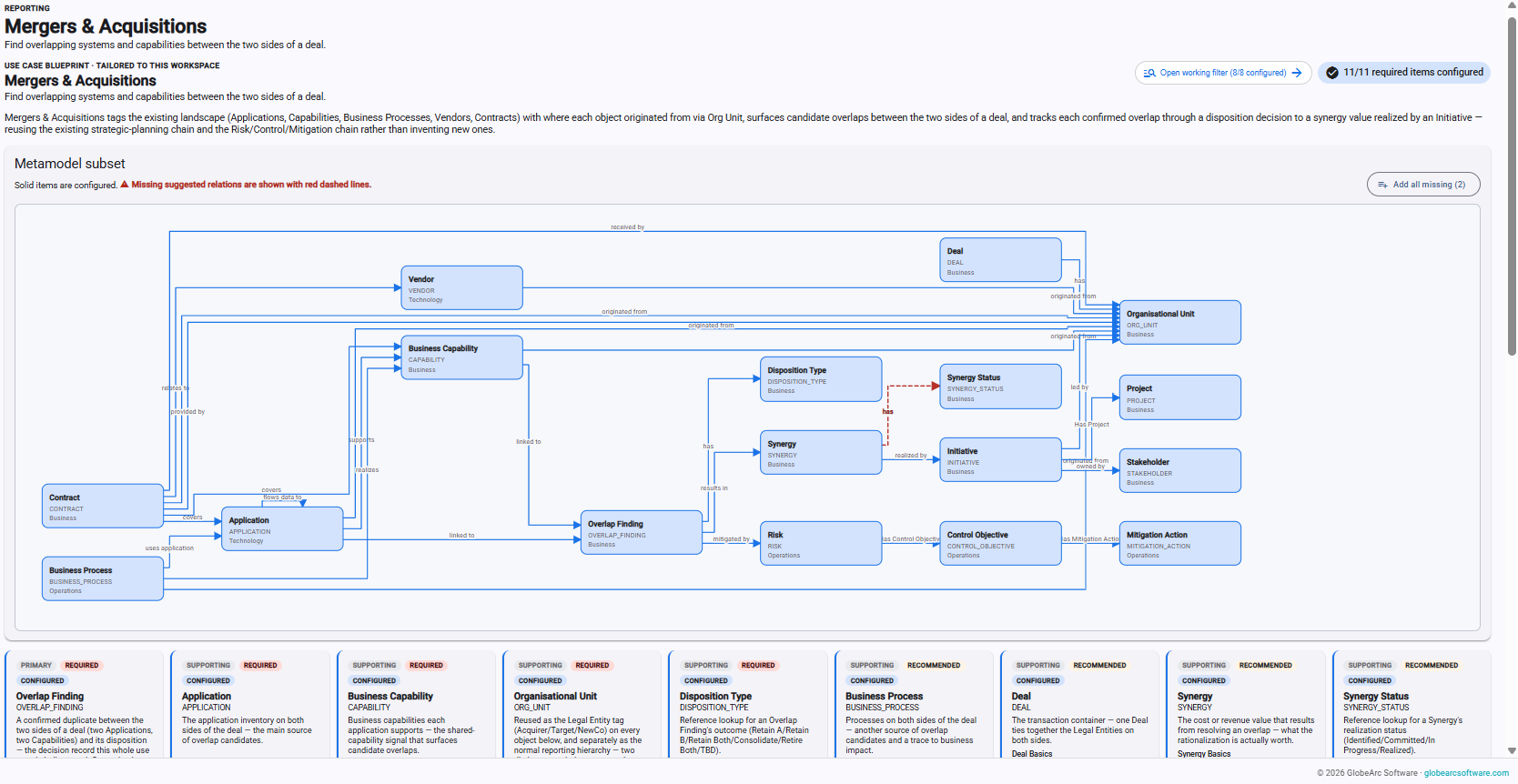
Mergers and Acquisitions IT integration starts with a deceptively simple question: where do the two organizations overlap, and what should be consolidated? GlobeArc brings applications, capabilities, organizational context, contracts, overlap findings, disposition decisions, and synergy information into one connected architecture view, helping teams understand the combined estate before making integration decisions.
The objective isn't to turn enterprise architecture into a merger program management system. GlobeArc focuses on the structural questions underneath the integration: which applications perform similar roles, where capabilities overlap, what each side of the deal brought into the combined estate, which systems are candidates for consolidation, what value has been identified, and what the post-merger Target architecture should become.


How Can Enterprise Architecture Support M&A IT Integration?
Enterprise architecture can support M&A IT integration by connecting the two technology estates to the business capabilities, organizational context, contracts, and decisions that explain why each system exists. That makes overlap analysis a connected data problem rather than a comparison of two independently maintained inventories.
GlobeArc can help teams investigate:
- Which applications came from each side of the transaction
- Where both organizations support the same capability with different systems
- Which applications appear to overlap
- Which contracts may create consolidation opportunities
- What disposition has been assigned to confirmed overlaps
- What synergy value has been identified, committed, or realized
- Which initiatives are expected to realize that value
- What the combined Target architecture should look like
This gives enterprise architects and integration leaders a common structure for discussing consolidation without reducing the exercise to a spreadsheet of application names.
What Should You Understand Before Integrating Two Technology Estates?
The first task is establishing a connected picture of both estates and identifying which side of the transaction each object came from. GlobeArc can use organizational context to distinguish applications and capabilities by origin while keeping them in the same repository.
That makes it possible to compare the organizations without maintaining two disconnected architecture models. Instead, teams can ask where applications, capabilities, contracts, and other objects overlap inside the combined estate.
Useful information can include:
- Application inventories from both organizations
- Business capabilities
- Application-to-capability relationships
- Organizational origin
- Application cost information
- Contracts and commercial exposure
- Confirmed overlap findings
- Disposition decisions
- Identified synergy values
- Current and Target architecture states
The deeper the relationship data, the more useful the analysis becomes. Application lists alone can show apparent duplication, but capability and organizational context help determine whether that duplication is meaningful.
How Can GlobeArc Support M&A Technology Due Diligence?
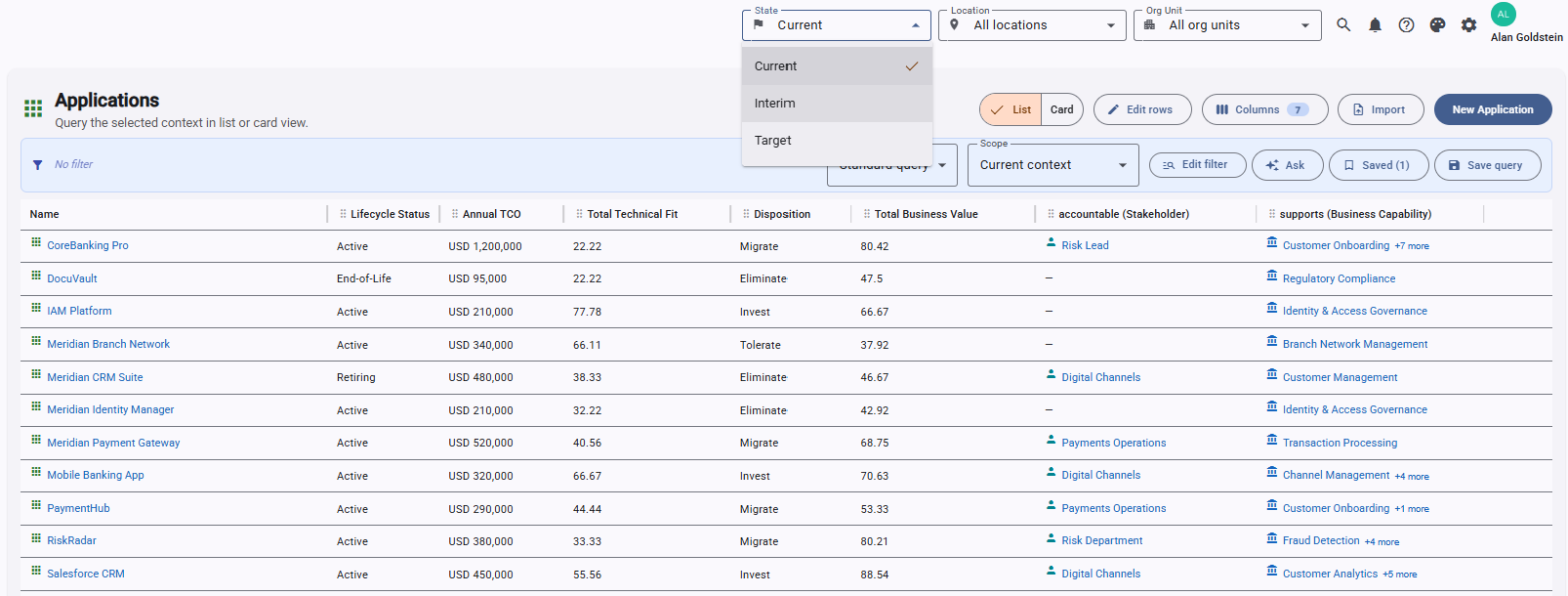
A connected application and capability view can support technology due diligence by helping teams understand the structure of the target estate before deeper integration decisions are made. The platform can provide architecture context around applications, capability coverage, organizational ownership, and known commercial relationships.
This can help due diligence teams investigate questions such as:
- Where does the target organization rely on duplicate or aging systems?
- Which applications appear to perform the same business role?
- Where are critical capabilities supported differently across the two organizations?
- Which contracts may constrain future consolidation?
- What parts of the estate may create additional integration complexity?
GlobeArc provides the connected technology and business architecture context that can strengthen the technology workstream.
How Do You Identify Duplicate Applications After an Acquisition?
Potential duplicate applications become easier to identify when systems are compared by the capabilities they support and the organization they originated from. Two applications from opposite sides of the transaction that support the same business capability become natural candidates for further overlap analysis.
That doesn't mean one should automatically be removed. Teams still need to understand technical conditions, business requirements, contracts, integrations, costs, and other dependencies before making a disposition decision.
A practical overlap analysis can examine:
- Applications from different sides of the deal
- Shared business capability coverage
- Similar business purpose
- Integration dependencies
- Contract constraints
- Current and Target architecture context
This moves the conversation from "these systems look similar" to "these systems appear to provide overlapping capability coverage, and here is the evidence we need to decide what happens next."
How Can Capability Mapping Reveal M&A Overlap?
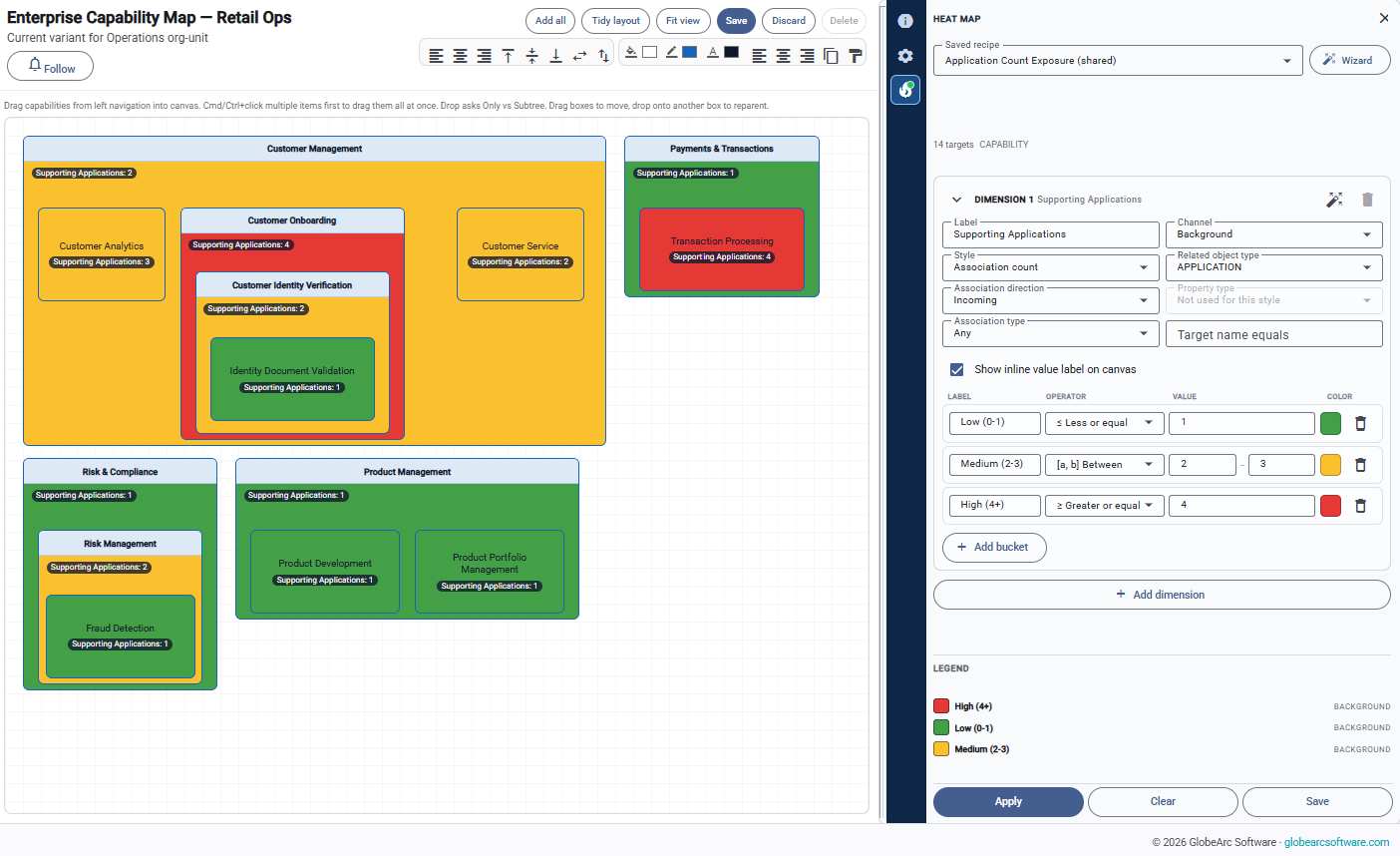
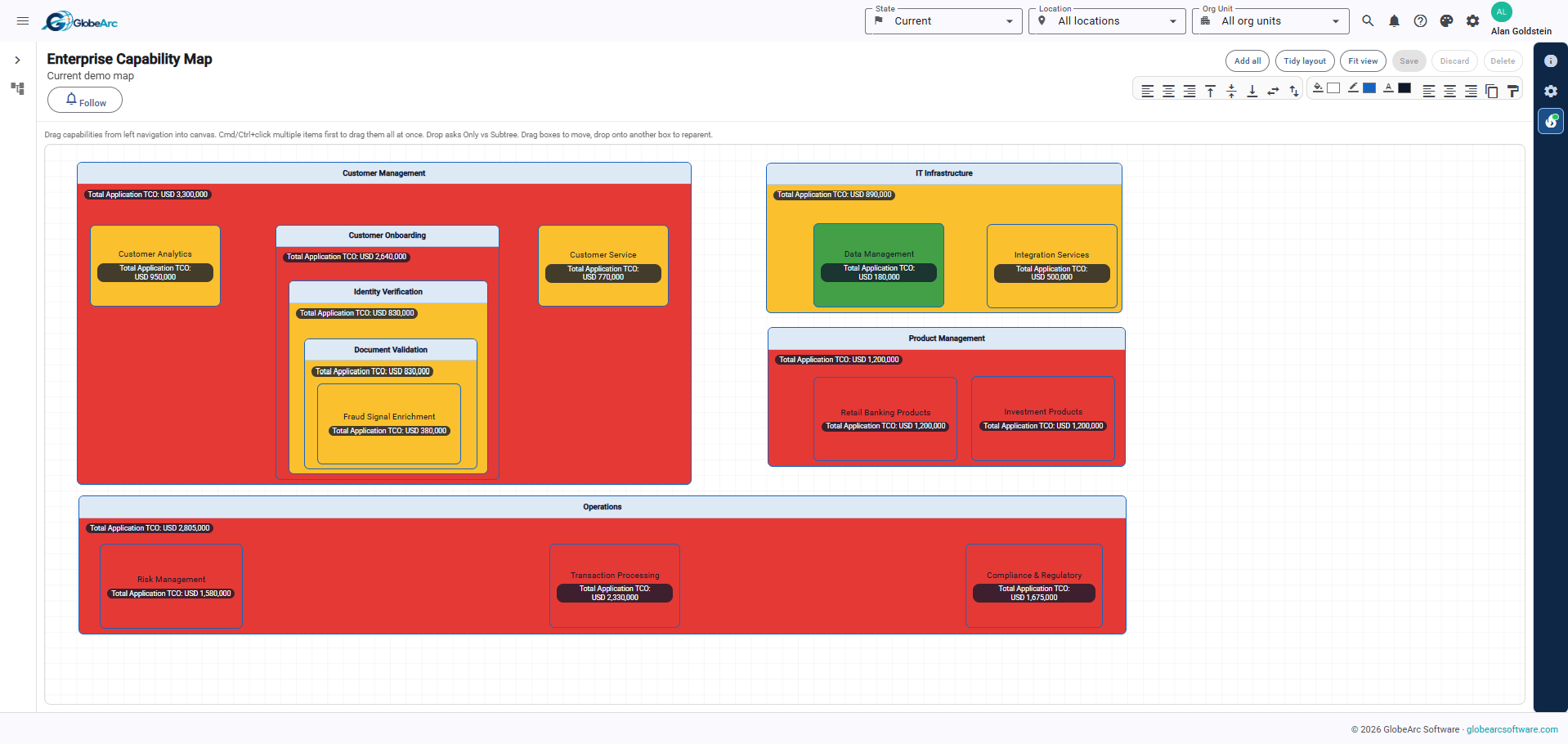
Capability mapping gives the two application estates a common business frame of reference. Rather than comparing product names or technical descriptions, teams can examine which applications support the same business capabilities across the combined organization.
That is particularly useful when the two companies use different terminology. The applications may have different names, owners, and technologies, but the business capability they support can reveal that they are solving the same underlying need.
GlobeArc can use this connected structure to surface areas where multiple applications support the same capability across different organizational origins. Those areas become candidates for deeper investigation, not automatic consolidation.

How Are M&A Disposition Decisions Tracked?
Confirmed overlap findings can be associated with disposition decisions so teams can distinguish between an identified overlap and an agreed course of action. That provides a clearer decision trail than leaving the outcome buried in workshop notes or a presentation.
Each confirmed overlap is assigned a Disposition Type: Retain A or Retain B (keep one of the two overlapping systems), Retain Both, Consolidate, Retire Both, or TBD while the decision is still open. These M&A dispositions are separate from the Tolerate, Invest, Migrate, and Eliminate Disposition used in application rationalization.
The value comes from connecting the disposition back to the overlap that produced it. Teams can see why the decision exists, which applications and capabilities are affected, and how it relates to the broader integration picture.
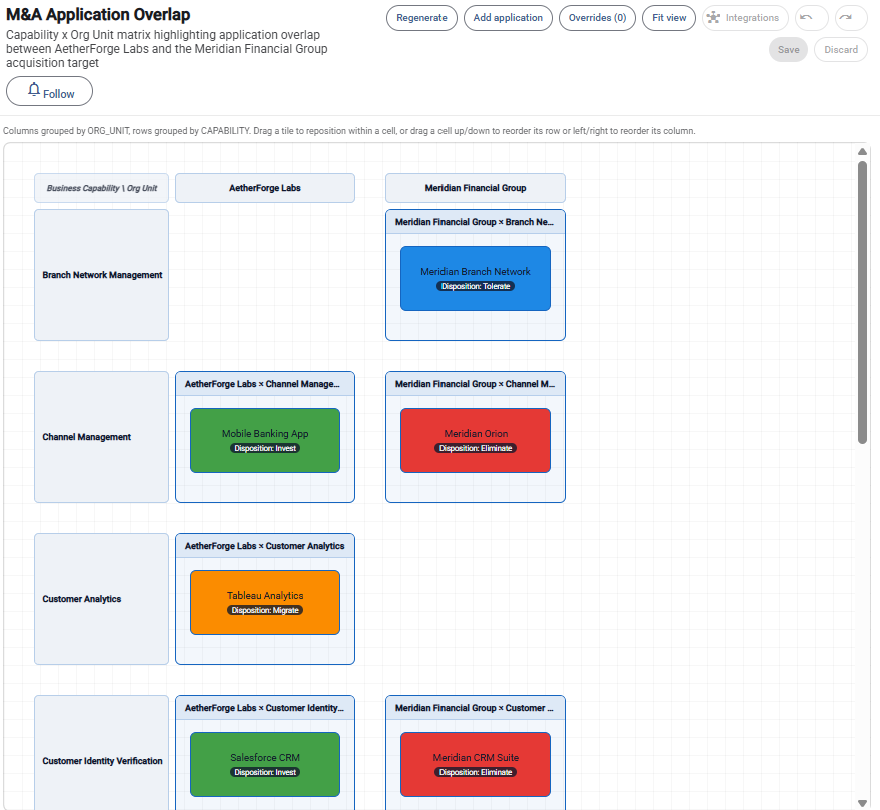
How Can an Application Overlap Matrix Clarify Consolidation Opportunities?
A two-dimensional application landscape can make overlap easier to see by showing applications across business capabilities and organizational units at the same time. This gives teams a visual way to understand where both sides of the transaction operate technology for the same business purpose.
The matrix is especially useful when the problem is too complex for a flat inventory. Instead of mentally joining application, capability, and organizational data, teams can examine those relationships in one structured view.
This can help identify:
- Capabilities supported by applications from both organizations
- Areas of high application concentration
- Potential consolidation candidates
- Gaps in capability coverage
- Organizational differences that may affect the decision
The visual overlap is the starting point. The disposition still depends on the underlying architecture and business context.

How Can Vendor and Contract Overlap Affect M&A IT Integration?
Vendor and contract information can reveal consolidation opportunities that aren't obvious from the application estate alone. Two apparently separate applications may be tied to the same vendor, different contract terms, transition service agreements, renewal dates, or commercial commitments that affect the timing and value of consolidation.
GlobeArc can represent contract information alongside the application and overlap structure, allowing teams to examine factors such as:
- Contract type, including Transition Service Agreements (TSAs)
- Expiration date
- Consolidation status
- Monthly cost
This doesn't replace procurement or contract management. It provides architecture and commercial context that can inform integration decisions.
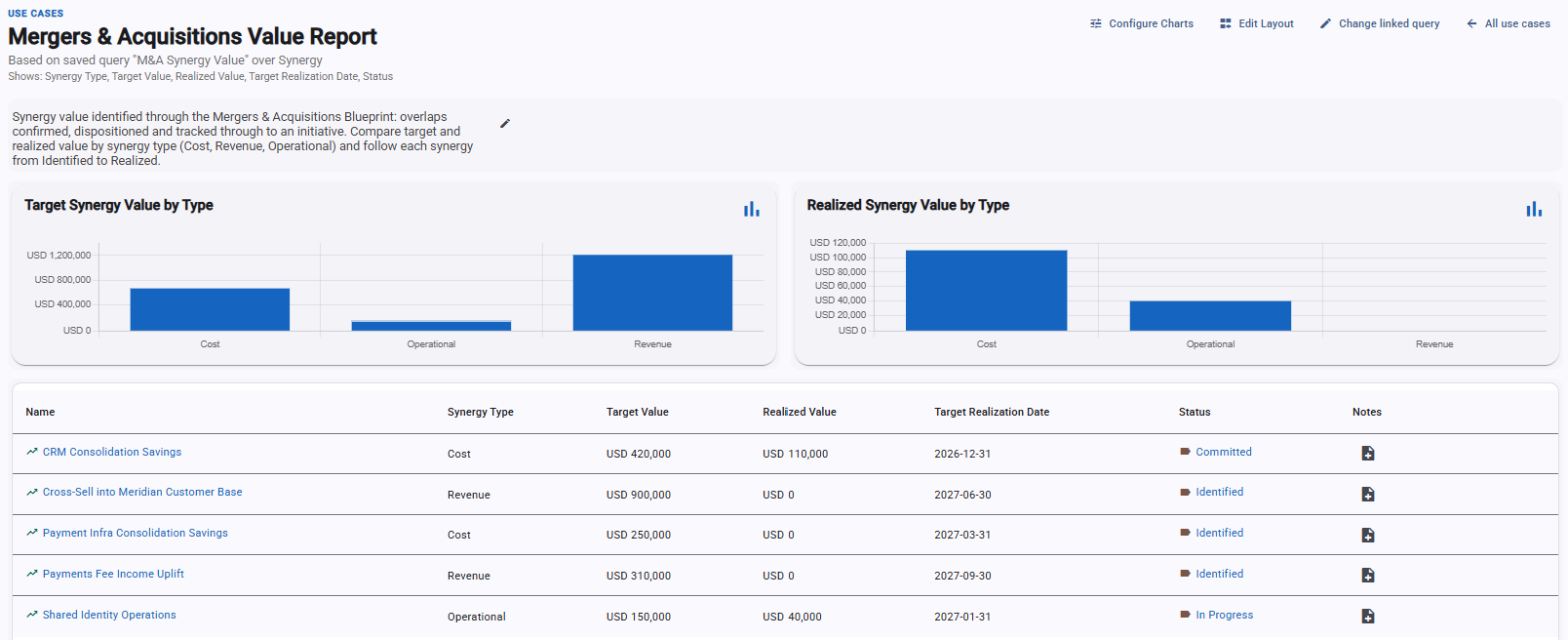
How Does GlobeArc Track Synergy Value?
Synergy can be tracked through Identified, Committed, In Progress, and Realized states, giving teams a clearer view of how much value has moved from opportunity to integration plan to active delivery to completed outcome. Each synergy is classified as Cost, Revenue, or Operational and carries a Target Value, a Realized Value, and a Target Realization Date, so teams can compare target and realized value by synergy type. The value itself comes from the organization's overlap findings rather than from a GlobeArc estimate.
This distinction is important. GlobeArc doesn't estimate the synergy opportunity for the customer. Teams record the value associated with confirmed findings, and GlobeArc can total and track that value as its status changes.
The resulting view can help answer:
- How much synergy has been identified?
- How much has been committed in the integration plan?
- How much has been realized?
- Which overlap findings contributed to that value?
- Which initiatives are expected to realize it?
This gives the architecture and integration team a stronger connection between estate decisions and the financial case behind the transaction.

How Can GlobeArc Reduce M&A Integration Risk?
GlobeArc reduces M&A integration risk by showing the dependencies, business context, and constraints around an overlap before a consolidation decision is made. Teams can see which capabilities, applications, integrations, contracts, organizational units, and Target-State plans are connected to the systems under review.
That context helps teams identify where a change could create consequences beyond the application itself. Before replacing, consolidating, or retiring a system, they can investigate:
- Business capabilities affected
- Applications involved
- Organizational origin
- Integration dependencies
- Related contracts
- Current and Target states
- Initiatives connected to the expected synergy
The platform provides the structural picture needed to assess integration consequences.
How Can M&A Architecture Inform Integration Sequencing?
Architecture dependencies can help teams understand which consolidation decisions need to happen before, alongside, or after others. Applications with significant integrations, contract constraints, or critical capability coverage may require a different transition path from relatively isolated systems.
GlobeArc can provide the application, capability, contract, integration, and state context needed to inform those sequencing conversations. Teams can use that evidence to identify constraints and understand how one decision may affect another.
The detailed integration schedule remains outside GlobeArc.
Does GlobeArc Support Day-One Planning?
GlobeArc can provide architecture context that informs Day-One decisions, but it isn't a Day-One planning or integration program management platform. Teams can use the repository to understand which applications, capabilities, contracts, and dependencies matter to the transaction, but the actual Day-One plan should be managed in the organization's program and delivery tooling.
This distinction matters because the structural architecture and the execution plan solve different problems. GlobeArc helps establish what the combined estate contains and what the integration decisions affect. It doesn't manage the task plan for delivering those decisions.
Who Uses GlobeArc for M&A IT Integration?
C-Level leaders are typically interested in the financial outcome and whether the integration is delivering the value promised in the deal case. Enterprise architects do much of the detailed estate, overlap, capability, and Target-State analysis, while business architects can contribute to capability overlap, and operational risk teams may use the connected dependency picture to investigate integration exposure.
The same M&A information can therefore serve different questions without creating separate versions of the transaction architecture.
Post-Merger Target Architecture
How Do You Build a Post-Merger Target Architecture?
The post-merger Target architecture can be modeled by representing the intended future estate in a Target state while preserving the Current architecture for comparison. This gives teams a connected way to understand what should remain, disappear, change, or be introduced as integration progresses. Interim states can also represent meaningful transition architectures when the combined estate can't move directly from Current to Target.
A practical workflow can include:
1
Bring Both Application Estates into the Repository
Import application data from both organizations into a centralized repository to establish a unified view of the combined technology landscape.
2
Tag Objects by Organizational Origin
Identify which organization each application and architecture object belongs to, making it easier to distinguish the two estates throughout the integration process.
3
Connect Applications to Business Capabilities
Map applications to the business capabilities they support to understand functional coverage and identify areas where both organizations serve similar business needs.
4
Identify Potential Application Overlaps
Analyze the combined application landscape to discover duplicate systems, overlapping functionality, and opportunities to consolidate technology investments.
5
Confirm Overlap Findings
Review potential overlaps against business requirements, application functionality, and operational needs to validate which applications can be consolidated or rationalized.
6
Assess Contracts and Dependencies
Evaluate relevant vendor contracts, licensing arrangements, integrations, and technical dependencies to understand the implications of consolidation decisions.
7
Assign Disposition Decisions
Assign each confirmed overlap a Disposition Type: Retain A, Retain B, Retain Both, Consolidate, Retire Both, or TBD while the decision is still open.
8
Record Identified Synergies
Record the Cost, Revenue, or Operational synergy value tied to each confirmed overlap, with a target value and target realization date.
9
Define the Target Application Estate
Model the desired combined application landscape to reflect consolidation decisions, business priorities, and the long-term technology strategy.
10
Compare Current and Target States
Track differences between the existing application estates and the target landscape as integration progresses, helping stakeholders monitor changes, validate decisions, and measure progress toward the desired outcome.
What Data Is Needed for M&A IT Integration?
The core analysis depends on enough information to distinguish the two estates and connect applications to their business purpose. Application and capability information provides the foundation, while contract, overlap, synergy, and integration data add depth.
Useful inputs include:
- Applications from both organizations
- Business capabilities
- Organizational origin
- Application-to-capability relationships
- Application costs
- Application integration relationships
- Deal context
- Overlap findings
- Disposition decisions
- Contracts
- Synergy values and statuses
- Current, Interim, and Target states
Objects and property values can be loaded through GlobeArc's guided import capabilities. The GlobeArc team helps plan how relationship data from both organizations is brought in during onboarding.


What Outputs Support M&A IT Integration Decisions?
GlobeArc can produce connected architecture, overlap, disposition, and synergy views that help teams move from estate discovery to a clearer post-merger architecture. Because these outputs share the same underlying repository, teams can move from portfolio-level patterns into the applications, capabilities, contracts, and findings behind them.
Useful outputs can include:
- Combined application portfolio views
- Application overlap candidates
- Capability overlap analysis
- M&A Application Overlap Matrix
- Disposition decisions
- Confirmed Overlap Findings
- Contract consolidation context
- Identified, Committed, In Progress, and Realized synergy
- M&A Synergy Value analysis
- Mergers and Acquisitions Value Report
- Current versus Target architecture comparisons
- Post-merger Target-State views
These outputs provide a common evidence base for enterprise architects, integration leaders, technology executives, and other stakeholders making consolidation decisions.
What Other EA and BPM Solutions Support Post-Merger Integration?
M&A integration commonly leads directly into application rationalization, modernization, target-state planning, and vendor consolidation. The combined repository created for the transaction can support those adjacent decisions rather than becoming another temporary integration artifact.
Related solutions include:
- Application Rationalization
- Application Modernization and Landscape Management
- Transformation and Target-State Planning
- Vendor Concentration and Risk
Build a Clearer Post-Merger Technology Estate
The difficult part of M&A IT integration isn't finding two application inventories. It's deciding where they overlap, what should happen to those overlaps, what value the decisions are expected to create, and what the combined estate should ultimately become.
GlobeArc connects applications, capabilities, organizational origin, contracts, overlap findings, disposition decisions, synergy, and architecture states so teams can move from two technology estates toward one defensible Target architecture.

We’re here to help you bring clarity to complexity.