
Strategy to Execution
Strategy to Execution
Strategy to Execution: Connect Investment to Business Priorities
The problem for many organizations isn't defining strategy. It's knowing whether the work being funded actually supports that strategy, who owns the change, and which parts of the business are expected to move as a result.
GlobeArc gives leaders, strategy teams, and architecture teams a connected view from strategic intent through execution.
Goals, objectives, initiatives, projects, capabilities, processes, and organizational context can be traced through the same repository, making it easier to see where investment is aligned, where execution has drifted, and where strategic priorities lack clear ownership or delivery activity.


What is Strategy to Execution?
Strategy to execution connects what an organization says it wants to achieve with the work, investment, and business change intended to make it happen. A useful strategy-to-execution framework should make it possible to trace from a strategic priority into the initiatives and projects being funded, then into the capabilities and processes those investments are expected to change.
That traceability matters because execution rarely fails simply because there aren't enough projects. More often, organizations have too many competing initiatives, unclear ownership, or work that continues without a strong connection to current strategic priorities.
Why Does Strategy Lose Its Connection to Execution?
Strategic plans and delivery portfolios are often managed in different systems, by different teams, and on different planning cycles. Over time, initiatives accumulate, project priorities change, budgets move, and the original connection between investment and strategy becomes harder to explain.
Common symptoms include:
- Strategic priorities with no clear operational owner
- Initiatives that don't clearly support a strategic goal
- Projects that continue after the rationale behind them has changed
- Competing investments aimed at similar business outcomes
- Capabilities receiving significant investment without a clear strategic reason
- Strategic goals with little visible execution activity behind them
- Transformation work that can't be traced back to an approved priority
The result is a portfolio that may be busy without being demonstrably aligned.
How Can Leaders Trace an Investment Back to Strategy?
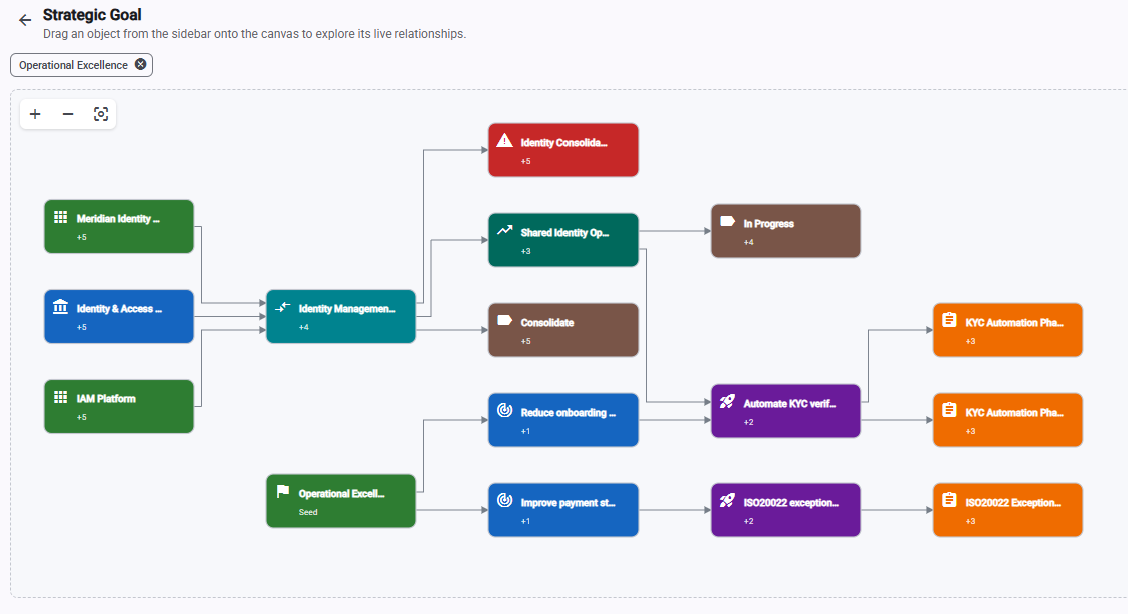
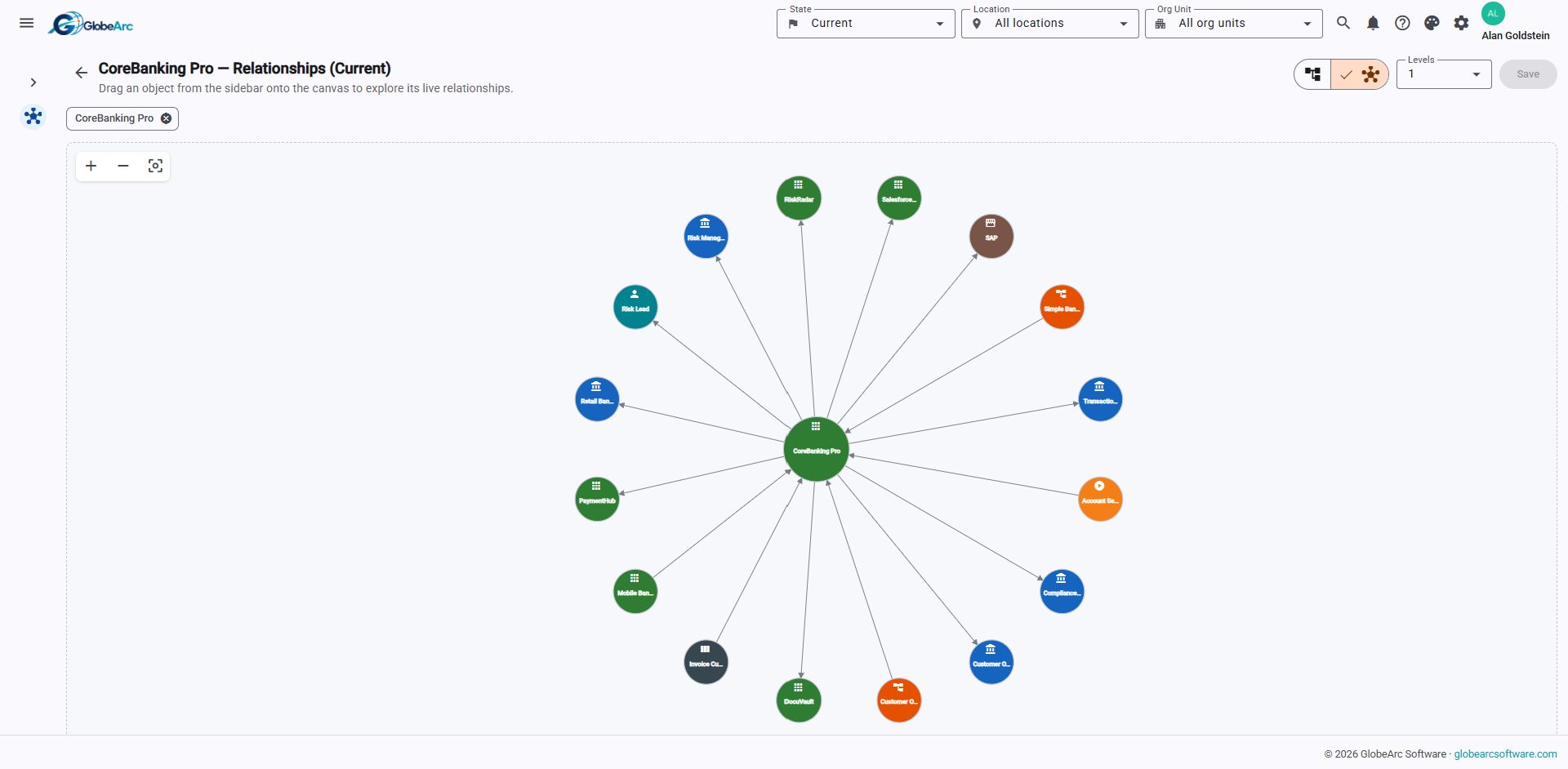
A funded initiative or project should be traceable back to the objective and strategic goal that justify it, while also showing which part of the business the investment is intended to change. GlobeArc connects these elements so leaders can move in either direction, from strategy into execution or from a project back to its strategic rationale.
A connected trace can include:
Strategic Goal → Objective → Initiative → Project → Capability
The value isn't the hierarchy itself. It's the ability to answer why an investment exists, which priority it supports, what capability it is expected to improve, and whether those relationships still make sense as plans evolve.
How Do Strategic Goals, Objectives, Initiatives, and Projects Fit Together?
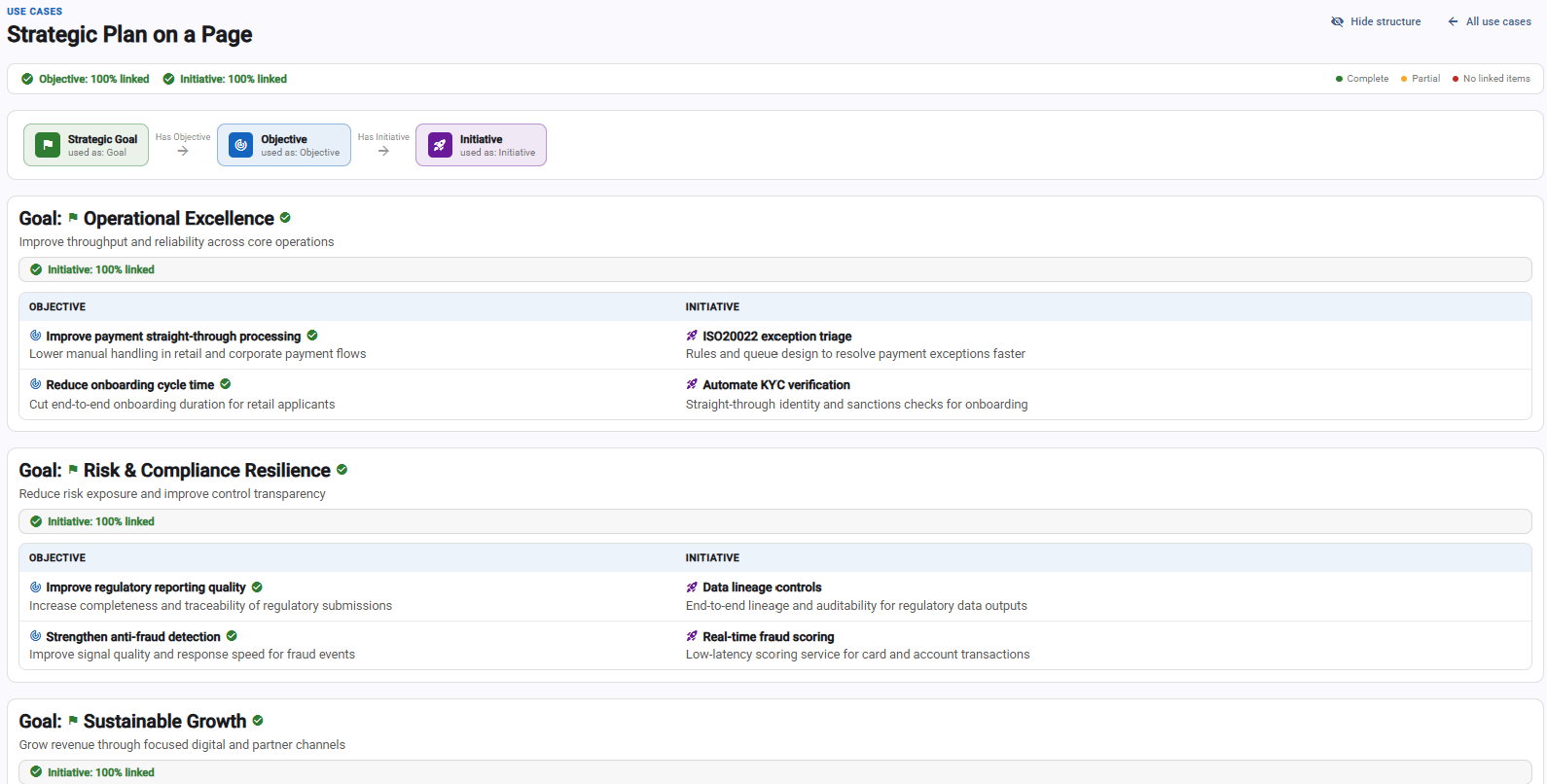
Strategic Goals set the direction, Objectives define the outcomes needed to support those goals, Initiatives organize the major changes required, and Projects deliver the specific work. Together, they create a traceable path from strategic intent to funded execution.
In GlobeArc, that structure can be connected to business capabilities, processes, and the wider enterprise context, so teams can see not only which projects support which goals, but also what parts of the business those investments are intended to change. Project details such as status, dates, and budget add delivery context without turning GlobeArc into a project management system.
How Do Business Capabilities Connect Strategy to Execution?
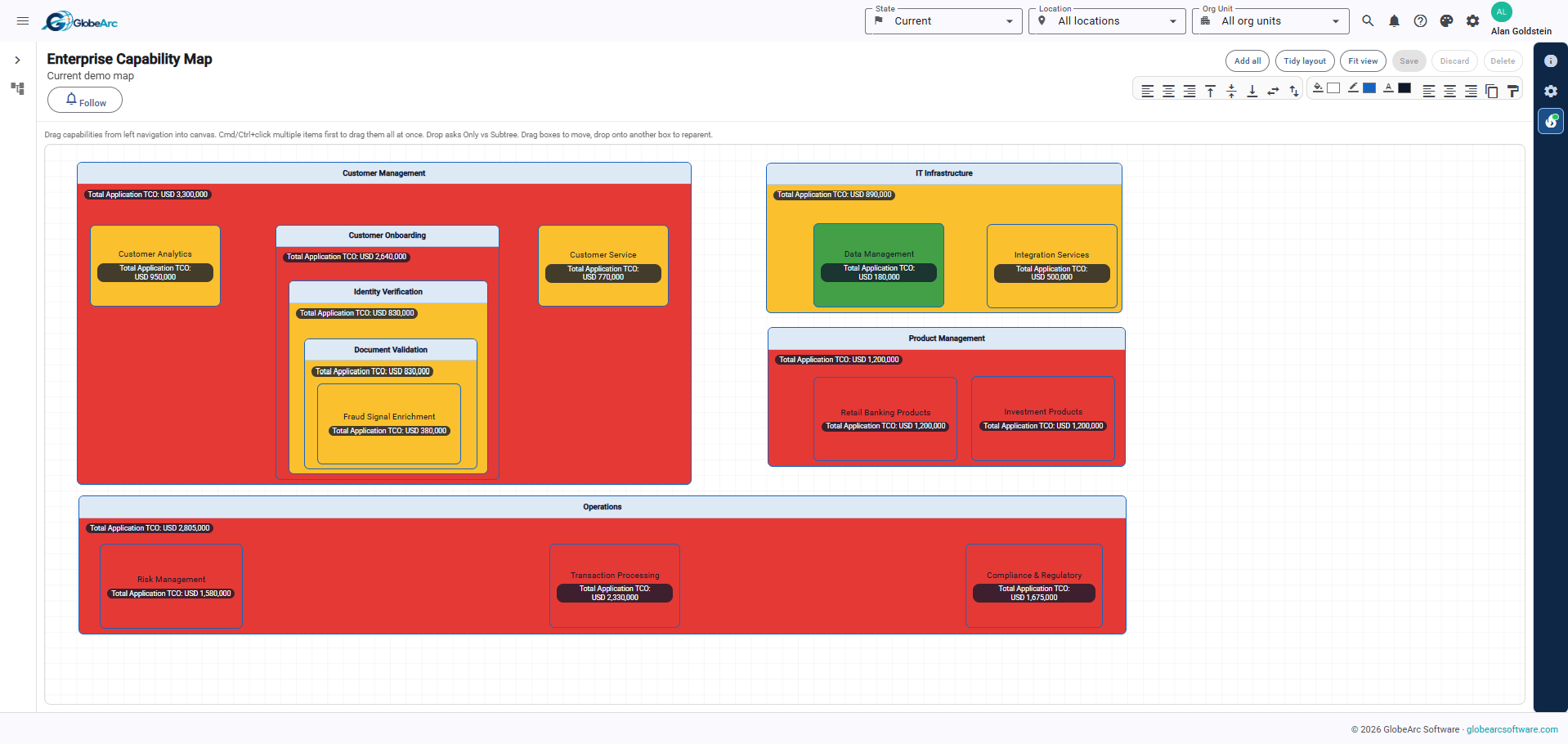
Business capabilities show what part of the organization an initiative is intended to strengthen, change, or create. Connecting strategy to capabilities adds business meaning to the execution chain because it identifies the operating ability that investment is expected to affect.
This helps leaders move beyond administrative alignment. Instead of knowing only that Project A supports Objective B, they can understand that the investment is intended to change a specific capability, which can then be connected to processes, applications, organizational units, and other parts of the enterprise.
That makes capability strategy alignment useful for questions such as:
- Which capabilities are receiving strategic investment?
- Which important capabilities have little or no funded change activity?
- Where are several initiatives competing around the same capability?
- Which applications and processes may be affected by a strategic change?
- Where does strategic intent depend on business areas that aren't yet represented in the delivery portfolio?

How Do Process Dependencies Strengthen Strategic Traceability?
Business processes show how strategic change reaches day-to-day operations. Connecting initiatives and capabilities to the processes they affect helps teams understand where execution depends on operational change, which parts of the business may be impacted, and where additional coordination may be required.
This is particularly useful when a strategy sounds clear at the executive level but becomes ambiguous during delivery. Architecture relationships can reveal which processes, systems, teams, and other enterprise elements sit behind the capabilities being changed.

How Can Leaders See Where Investment is Being Directed?
Project and initiative information can be connected to strategic goals and capabilities, giving leaders a clearer picture of where investment is flowing across the organization. Project properties can include information such as budget, status, start date, and end date, while calculated properties can support additional analysis when the required data is available.
The important benefit is context. A budget figure becomes more useful when leaders can see what strategic priority it supports and what capability the investment is intended to change. This helps shift the discussion from total spend alone to whether investment is supporting the strategic outcomes and business capabilities the organization has prioritized.
How Can You Identify Initiatives With Weak Strategic Alignment?
Weak alignment becomes visible when initiatives or projects can't be traced confidently to current strategic priorities or when their connection is too indirect to defend. GlobeArc's connected repository and query capabilities can help teams surface these gaps instead of relying on periodic manual reconciliation.
Teams can investigate areas such as:
- Projects with no clear strategic ancestry
- Initiatives that aren't connected to a defined objective
- Goals with no funded initiatives behind them
- Capabilities receiving investment from several competing initiatives
- Projects whose strategic rationale has become unclear
- Delivery activity that no longer supports the current strategic direction
These aren't automatic cancellation candidates. They are signals that leadership should review the rationale, ownership, or continued priority of the work.


How Does GlobeArc Help With Project Portfolio Alignment?
GlobeArc helps assess whether the project portfolio is connected to strategic priorities and business capabilities, rather than trying to manage the detailed mechanics of project delivery. Leaders can use the architecture relationships to see where investment is concentrated, where alignment is weak, and which areas of the business are being changed.
This supports portfolio-level questions such as:
- Which strategic goals have the most funded activity?
- Which objectives have little execution behind them?
- Which capabilities are attracting multiple investments?
- Which projects appear disconnected from strategy?
- Where are competing initiatives pursuing similar outcomes?
- Which parts of the organization are carrying the greatest change load?
How Does GlobeArc Support Ownership and Accountability?
Connected architecture makes accountability clearer by showing who or what sits around a strategic commitment, rather than leaving ownership implicit in presentations or meeting notes. Depending on the organization's configured metamodel, initiatives, projects, capabilities, organizational units, and stakeholders can be connected to provide a clearer view of responsibility.
That context can help reveal where execution lacks a clear owner, where several groups appear responsible for the same outcome, or where a strategic priority has been published without an obvious delivery path.
How Can Current and Target States Support Strategy Execution?
Current and Target states allow teams to compare the architecture that exists today with the architecture strategic execution is intended to create. That makes it easier to understand whether funded change is connected to a defined future state rather than simply producing more activity.
Teams can use state comparison to examine how relevant objects and properties differ between Current and Target perspectives. Interim states can also represent meaningful stages between the two when transformation doesn't happen in one step.
This gives strategy execution a stronger architecture dimension: not only what work is being funded, but what future enterprise that work is supposed to produce.
What Questions Can Leaders Answer?
Questions can include:
- Which projects support each strategic goal?
- Which initiatives have no clear connection to an objective?
- Which strategic priorities have little funded execution behind them?
- Which capabilities are receiving the most investment?
- Where are multiple initiatives competing around the same business area?
- Which projects appear to have no clear strategic ancestry?
- What business capabilities depend on a particular strategic initiative?
- Which processes and applications may be affected by the planned change?
- How does the Target architecture differ from the Current state?
- Has the relationship between strategy and execution changed since the plan was approved?
These questions help leadership review not only whether work is progressing, but whether the organization is progressing toward the right outcomes.
What Information Supports Strategy-to-Execution Traceability?
Strategy-to-execution traceability depends on strategic goals, objectives, initiatives, projects, ownership, investment data, capability relationships, and architecture context. Together, these inputs show why work exists, what it supports, who is accountable, and which parts of the business are expected to change.
Useful inputs can include:
- Project status
- Project start and end dates
- Project budgets
- Initiative-to-capability relationships
- Strategic relationships to capabilities
- Relevant organizational or stakeholder ownership
- Current, Interim, and Target architecture context
These inputs provide the evidence needed to connect strategic priorities with execution and assess whether funded work remains aligned with the organization's intended direction.
How Do Strategy-to-Execution Outputs Support Leadership Decisions?
Outputs help leaders see whether strategic intent, funded activity, and enterprise change remain connected as priorities evolve. Instead of relying on a static mapping assembled for a planning cycle, teams can investigate the underlying relationships and identify where alignment needs attention.
Useful views and analyses can include:
- Strategic Plan on a Page
- Goal-to-project traceability
- Initiative-to-capability relationships
- Project status and budget context
- Queries for poorly aligned or orphaned work
- Capability investment patterns
- Current versus Target comparisons
- Connected business, process, and technology relationships around strategic change
These views support strategic review without pretending that architecture software should replace project delivery or portfolio management platforms.

Is GlobeArc a Project Portfolio Management Platform?
GlobeArc isn't a PPM platform. It doesn't provide detailed resource management, capacity planning, task scheduling, project dependency management, or full portfolio delivery workflows.
Its role is to connect strategic intent to the initiatives, projects, capabilities, processes, applications, and other enterprise elements affected by that intent. Organizations can continue running delivery in their existing project and portfolio tools while using GlobeArc to understand whether the work remains connected to strategy.
That distinction is important. The problem GlobeArc addresses is strategic traceability, not project administration.
Who Uses GlobeArc for Strategy to Execution?
Executives and transformation leaders use the connected view to understand whether investment supports the organization's stated priorities. Business architects can examine which capabilities strategy is changing, while enterprise architects can trace those changes into processes, applications, and the wider enterprise architecture.
What Other EA and BPM Solutions Support Strategy Execution?
Strategy execution often leads into Target-State planning because leaders need to understand not only what they're funding, but what the organization should look like when the investment is complete. It also intersects with modernization when strategic priorities require significant changes to the technology estate.
Related solutions include:
- Transformation and Target-State Planning
- Application Modernization and Landscape Management
- Application Rationalization
- Mergers and Acquisitions Integration
- Process Standardization Across Locations and Organizational Units
Connect Strategic Intent to the Change it Funds
A strategy document can describe where the organization wants to go, and a project portfolio can show what teams are delivering. The difficult part is proving that the two still connect.
GlobeArc provides the traceability between strategic priorities, initiatives, projects, capabilities, processes, and the wider architecture. That gives leaders a clearer way to ask why an investment exists, what it is expected to change, who is accountable, and whether the work being funded is still moving the organization toward its intended future.

We’re here to help you bring clarity to complexity.